
In this article
- What Is a Digital Label Under CLP?
- Timeline of the New CLP Digital Labelling Rules
- Will QR Codes Replace Chemical Labels?
- What Information Can Be Provided Digitally?
- What Legal Requirements Must Digital Labels Meet?
- Example: What Happens When a Product Classification Changes?
- Challenges of Digital Labelling
- Managing Digital Labels at Scale
- How Valid Labels Helps Prepare for Digital Labelling
- FAQ
- The Future of Chemical Labelling Is Digital
The European Union is modernising the way hazardous chemical products are labelled through the revised CLP Regulation (EU) 2024/2865.
One of the most significant changes is the introduction of digital labels, allowing certain product information to be provided electronically through QR codes and other digital data carriers.
Although the physical CLP label remains mandatory, companies placing hazardous chemical products on the EU market will soon be able - and in some cases expected - to provide supplementary information digitally. This creates new opportunities to improve access to product information while also introducing additional compliance obligations.
The new rules are relevant not only for manufacturers, but also for importers, downstream users, distributors and other suppliers responsible for placing hazardous products on the EU market.
In this article, we explain:
- what digital labels are under the revised CLP Regulation;
- how QR codes and other digital data carriers can be used;
- which information may be provided digitally;
- what legal requirements digital labels must meet; and
- how companies can prepare for the transition.
What Is a Digital Label Under CLP?
A digital label is an electronic source of product information that can be accessed through a data carrier, such as a QR code printed on the product packaging.
The revised CLP Regulation introduces digital labelling to improve access to supplementary product information while ensuring that essential hazard communication remains available on the physical label.
The objectives of digital labelling include:
- improving label readability;
- reducing space limitations on packaging;
- supporting multilingual product information;
- making supplementary safety information easier to access;
- simplifying regulatory updates; and
- improving access to information throughout the product lifecycle.
Digital labels are particularly valuable for companies marketing products across multiple EU Member States, where multilingual labelling requirements often leave very limited space on physical packaging.
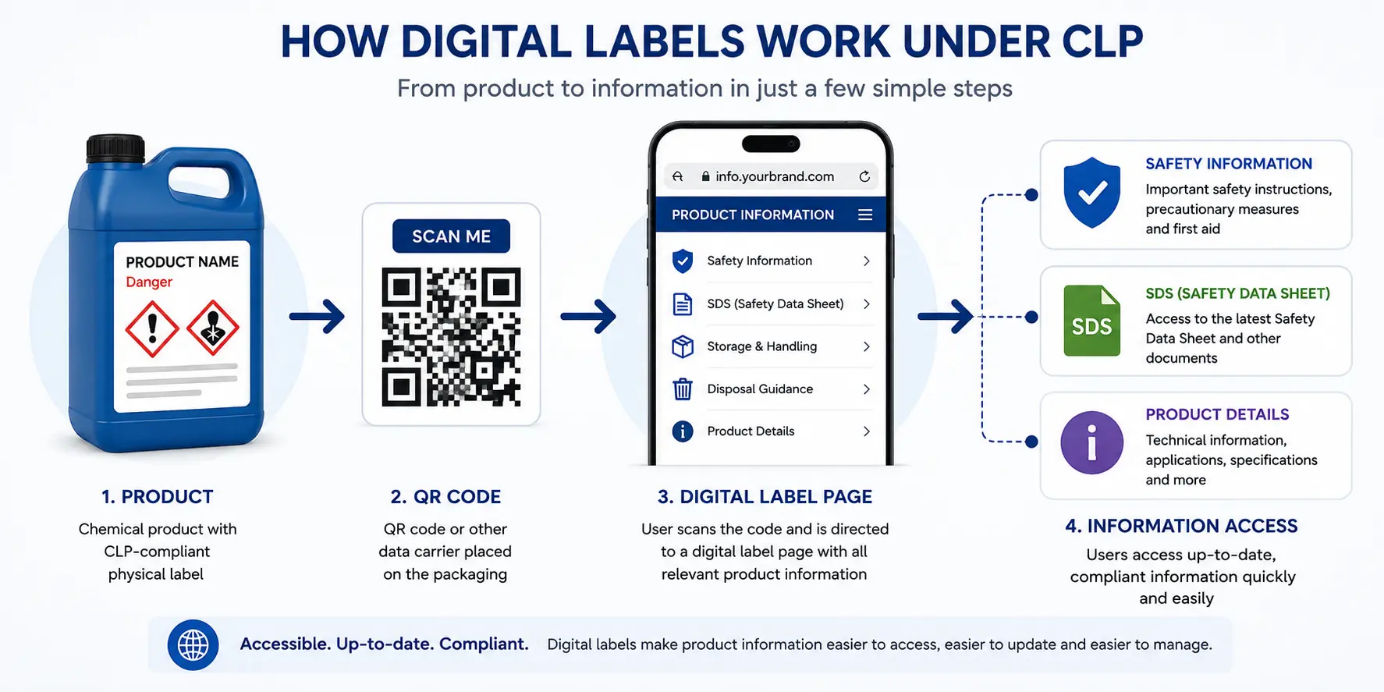 CLP digital label workflow showing a product, QR code, digital label page, safety information and SDS access
Timeline of the New CLP Digital Labelling Rules
The digital labelling provisions are part of the broader revision of the CLP Regulation. Although some requirements will not apply immediately, manufacturers should begin preparing now, especially if they manage large product portfolios or sell products in multiple EU markets.
Will QR Codes Replace Chemical Labels?
No.
This is one of the most common misconceptions about the revised CLP Regulation.
The physical label remains mandatory and continues to play a central role in hazard communication.
The following information must still appear directly on the packaging:
- hazard pictograms;
- signal words;
- hazard statements (H-statements);
- precautionary statements (P-statements);
- supplier information; and
- other core CLP elements.
A QR code is intended to complement the physical label rather than replace it.
For companies, this means managing both printed and digital product information simultaneously.
What Information Can Be Provided Digitally?
The revised regulation allows certain supplementary information to be provided digitally.
Examples may include:
- additional product details;
- storage recommendations;
- disposal guidance;
- supplementary safety instructions;
- technical product information;
- links to Safety Data Sheets (SDS); and
- multilingual product information.
Providing this information digitally allows companies to share more comprehensive content without overcrowding physical labels.
What Legal Requirements Must Digital Labels Meet?
Creating a QR code is only a small part of complying with the revised CLP Regulation. The real challenge is ensuring that the information accessible through the digital label complies with the legal requirements set out in the Regulation.
Digital information must be:
- freely accessible;
- available without registration or login;
- accessible without downloading a dedicated mobile application;
- easy to locate after scanning the data carrier;
- presented in a clear and user-friendly format;
- kept up to date whenever product information changes; and
- available for at least 10 years after the product is placed on the market.
The purpose of these requirements is to ensure that digital labels improve access to safety information rather than create additional barriers for users.
Companies should therefore view digital labels as part of their regulatory information management process - not simply as webpages linked to QR codes.
Example: What Happens When a Product Classification Changes?
Imagine a cleaning product receives an updated classification due to new regulatory requirements.
Without a structured system, the manufacturer may need to:
- update the CLP label;
- update the digital label page;
- update the Safety Data Sheet;
- verify translations in all required languages; and
- ensure the QR code still directs users to the latest version.
For companies managing hundreds or thousands of products, these updates can quickly become difficult to track manually. See the AFL Laboratories case study for an example of the operational scale involved.
Challenges of Digital Labelling
Digital labelling offers significant benefits, but it also introduces new operational responsibilities.
Companies placing hazardous chemicals on the EU market need to ensure:
- multilingual content remains accurate;
- product information stays synchronised across all channels;
- regulatory changes are reflected immediately;
- digital information remains available for at least ten years;
- QR codes and other data carriers always point to the correct information; and
- product portfolios remain manageable as they grow.
Without centralised information management, maintaining compliance can become resource-intensive and prone to human error.
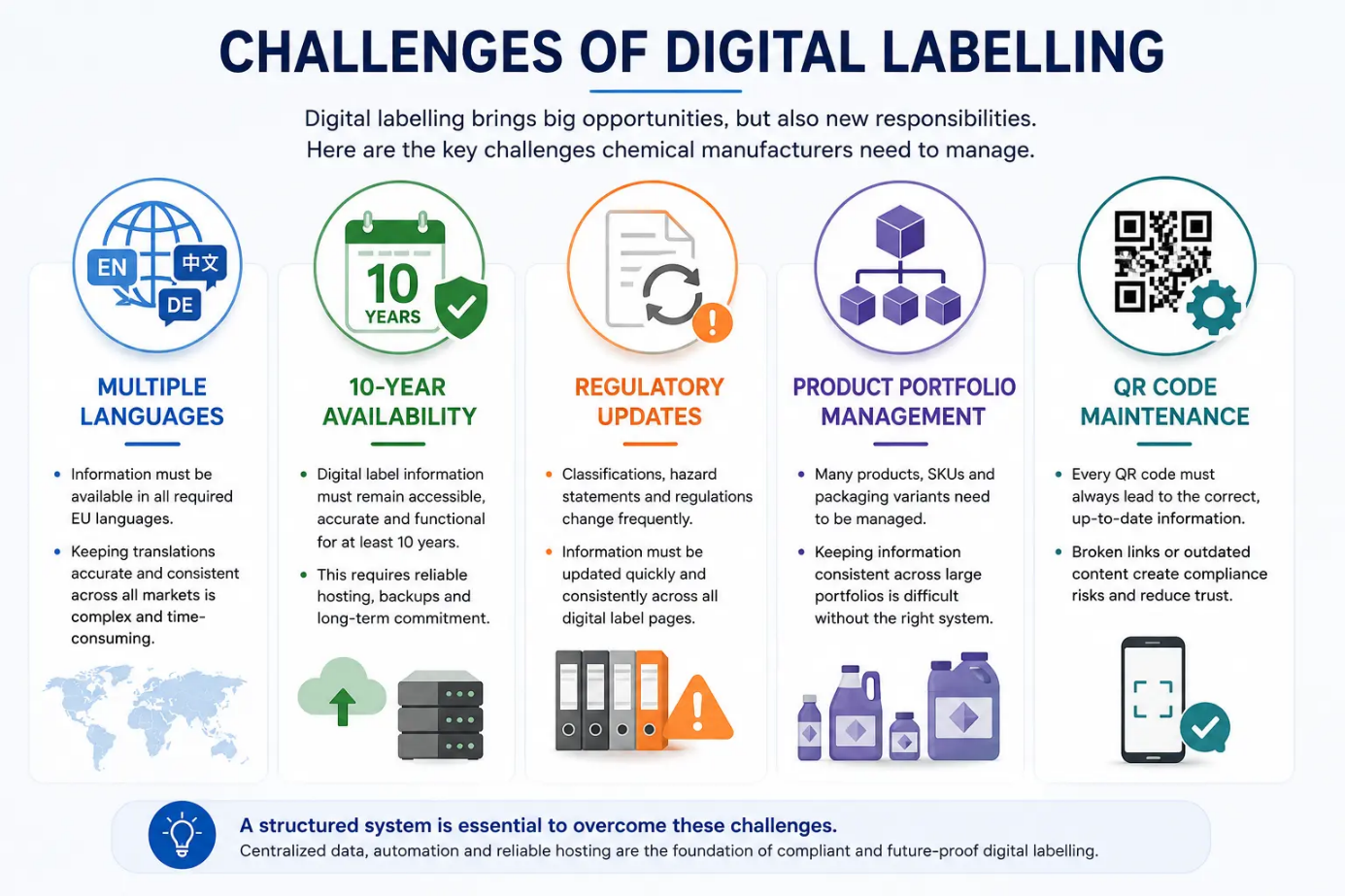 Key challenges of digital labelling for chemical manufacturers including multilingual content, regulatory updates, QR code maintenance and long-term data availability
Managing Digital Labels at Scale
Meeting the new requirements requires much more than a QR code generator.
Companies need a platform capable of managing product information throughout its entire lifecycle.
An effective digital labelling solution should provide:
- centralised product data management;
- version control;
- multilingual content management;
- automated label update workflows;
- secure long-term hosting;
- complete audit trails;
- integration with Safety Data Sheets; and
- support for future regulatory changes.
Building these capabilities early allows organisations to prepare for future digitalisation requirements while reducing the administrative burden of ongoing compliance.
How Valid Labels Helps Prepare for Digital Labelling
Platforms such as Valid Labels help centralise regulatory information and maintain consistency between physical and digital labels.
Centralised Label Data
Instead of managing information across spreadsheets, PDFs and disconnected systems, teams can maintain product data in a single location. This reduces the risk of inconsistencies and outdated information.
Easier Regulatory Updates
When classifications, hazard statements or regulatory requirements change, updates can be managed centrally rather than manually across multiple files and systems.
Multilingual Information Management
Digital labels often require content in multiple languages. Valid Labels helps companies organise and maintain multilingual product information for different EU markets.
Supporting Future QR-Code Workflows
As digital labelling becomes more common, companies will need efficient ways to connect products with online information. Valid Labels provides the foundation needed to support scalable and compliant digital labelling processes.
FAQ
Are QR codes mandatory under the new CLP Regulation?
The revised CLP Regulation introduces the possibility of providing certain information digitally through QR codes and other data carriers. The exact implementation depends on the type of product and information being provided.
Can a QR code replace a CLP label?
No. Essential hazard communication elements must remain on the physical label.
What information must remain on the physical label?
Hazard pictograms, signal words, hazard statements, precautionary statements and other core CLP elements must still appear on the packaging.
Do digital labels need to be available in multiple languages?
Yes. Information must be provided in the language or languages required by the Member State where the product is marketed.
How long must digital label information remain available?
Digital label information must remain accessible for at least 10 years.
Can Safety Data Sheets be linked through a QR code?
Yes. Digital labels may provide access to supplementary information, including Safety Data Sheets and other product-related documentation.
The Future of Chemical Labelling Is Digital
The introduction of digital labels represents one of the most significant changes to chemical labelling in recent years.
Although physical labels remain mandatory, the amount of information delivered digitally is expected to increase over time.
Companies that begin preparing now will be better positioned to meet future regulatory requirements, improve information accessibility and reduce compliance risks.
Digital labelling is coming. The question is whether your product information systems are ready?
Nikola Kopczyńska
Content Specialist, ValidLabels
Kasper Stasiak founded ValidLabels after working directly with European chemical exporters on CLP compliance workflows. ValidLabels is built by Awakast P.S.A., based in Wrocław, Poland.
Related articles
CLP Compliance
How to Launch a CLP-Regulated Product in a New EU Market
Expanding a chemical product into another EU country? Learn what to check before launch, from CLP labels and languages to UFI and poison centre notifications.
CLP Compliance
Multilingual CLP Labels: 5 Options for Selling Across Europe
Compare five ways to manage multilingual CLP labels across Europe, including single-language, multilingual, fold-out, overlay and print-on-demand labels.