
In this article
- Why Are the New CLP Rules Important for Ecommerce?
- Does CLP Already Apply to Online Sales?
- Advertisement vs Distance Sales Offer – What Is the Difference Under CLP?
- What CLP Information Should Be Displayed on an Ecommerce Product Page?
- Where Should CLP Information Be Placed on Product Pages?
- Is an SDS Alone Enough for Ecommerce Compliance?
- What Will Change in CLP from 2028?
- Which Marketing Claims Should Be Avoided?
- How to Prepare an Online Store for New CLP Requirements
- How Can Valid Labels Help?
- How Is CLP Enforced Across the EU?
- FAQ – CLP and Online Chemical Sales
- Conclusion
Online chemical sales are already subject to CLP requirements, yet many ecommerce stores still fail to display complete hazard information on their product pages.
At the same time, upcoming CLP revisions will make online sales requirements significantly more detailed. For manufacturers, importers, and ecommerce businesses, this means preparing:
- product pages
- online hazard labeling
- label images
- product data
- and compliance workflows
The biggest changes will apply from January 1, 2028, but some obligations are already in force today.
In this article, we explain:
- what CLP information must be displayed in online stores
- the difference between advertising and distance sales offers
- whether an SDS alone is sufficient
- what changes Article 48a CLP will introduce
- and how chemical ecommerce businesses can prepare before 2028
Why Are the New CLP Rules Important for Ecommerce?
The CLP revision aims to improve the safety of online chemical sales and standardize how hazard information is presented in ecommerce.
The European Commission emphasizes that customers should see hazard information before purchasing a product online.
This means that online stores selling:
- detergents
- cleaning products
- paints
- adhesives
- aerosols
- technical chemicals
- hazardous mixtures
will need to adjust how products are presented online.
For many companies, the challenge will not be CLP itself, but the operational scale of the changes:
- thousands of product pages
- multiple language versions
- SDS and label synchronization
- PIM/ERP data updates
- marketplace compliance
If you want to better understand chemical labeling fundamentals, see also: What is a CLP label?
Does CLP Already Apply to Online Sales?
Yes.
Contrary to common assumptions, online sales obligations do not begin only in 2028.
Article 48(2) CLP already states that advertisements for hazardous mixtures must include hazard information if customers can purchase the product without first seeing the physical label.
In practice, online product pages are treated as such offers or advertisements. This means:
- customers should see hazard information before purchase
- product pages should contain CLP information
- an SDS download link alone is usually not enough
Advertisement vs Distance Sales Offer – What Is the Difference Under CLP?
This is one of the most important distinctions introduced in the new ecommerce-related CLP rules.
Advertisement (Article 48 CLP)
An advertisement is promotional content that attracts customer attention but does not yet allow the purchase process to begin. Examples include:
- Facebook Ads
- display banners
- Google Ads
- YouTube ads
Distance Sales Offer (Article 48a CLP)
A distance sales offer is any page or interface that allows users to begin purchasing a product. In practice, this includes:
- product pages
- marketplace listings
- category pages with quick purchase options
- B2B ordering interfaces
The key factor is the ability to initiate a transaction, for example through buttons such as "Add to Cart", "Buy Now", or "Order".
What CLP Information Should Be Displayed on an Ecommerce Product Page?
This is one of the most common questions asked by companies selling chemicals online.
Today, the safest approach is to structure product pages similarly to the future Article 48a CLP requirements.
Recommended CLP elements on product pages:
CLP/GHS Hazard Pictograms
Visible hazard symbols such as flammability, toxicity, corrosive hazards, and environmental hazards.
Signal Word
For example: "Danger" or "Warning".
H Statements
Describing the type of hazard.
P Statements
Providing precautionary and safe-use instructions.
EUH Statements
Where applicable.
Supplier Information
Including responsible entity name, address, and EU contact details.
UFI Identifier
For products subject to UFI obligations. If you want to learn more about UFI and PCN requirements, it is worth preparing a separate compliance section for these processes as well.
Label Images
Ideally with front and back label views, zoom functionality, and readable label text. EU enforcement authorities often recommend label images as a practical way to present hazard information online.
Where Should CLP Information Be Placed on Product Pages?
The new ecommerce compliance approach is not only about the data itself, but also about its visibility to users.
In practice, hazard information should be:
- clearly visible
- readable on mobile devices
- accessible without downloading a PDF
- displayed close to the "Add to Cart" button
There is also increasing discussion around the concept of a "hazard information panel" — a dedicated CLP information section displayed directly on the product page.
Is an SDS Alone Enough for Ecommerce Compliance?
Usually not.
Authorities emphasize that customers should not be forced to download PDFs, hazard information should be visible directly on the product page, and an SDS does not replace mandatory online CLP information.
Safety Data Sheets remain important, especially in B2B sales, but they should not be the only source of information for consumers.
What Will Change in CLP from 2028?
The biggest change will be the introduction of Article 48a CLP for distance sales.
The new rules are expected to require online offers to clearly and visibly display the labeling elements defined in Article 17 CLP. This includes:
- product identifiers
- supplier information
- pictograms
- signal words
- H statements
- P statements
- supplemental EUH information
- UFI identifiers
The revised rules will also introduce more detailed requirements for hazardous product advertising.
In practice, many existing product pages will not meet the new requirements without significant redesign.
Which Marketing Claims Should Be Avoided?
CLP prohibits statements that downplay hazards or contradict the product's hazardous classification.
For hazardous products, problematic claims may include:
- "non-toxic"
- "harmless"
- "chemical-free"
- "safe"
- "eco" / "green" / "environmentally friendly"
Safer alternatives are specific and verifiable claims such as "phosphate-free", "solvent-free", or "readily biodegradable surfactants".
How to Prepare an Online Store for New CLP Requirements
The larger the product catalog, the more difficult last-minute implementation becomes. That is why preparation should begin early.
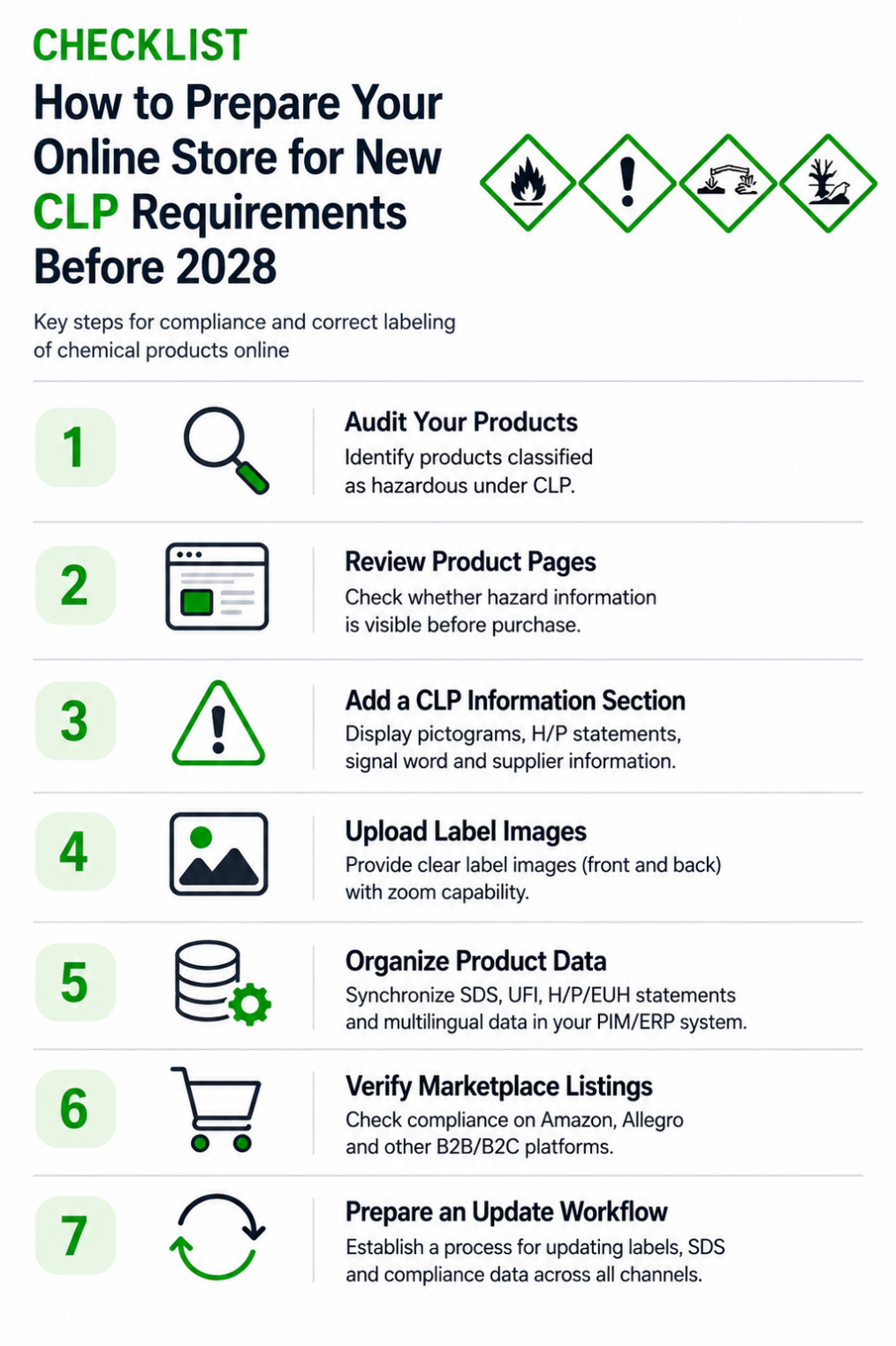 Checklist for preparing an online store for new CLP requirements before 2028
1. Identify Products Subject to CLP
Review all hazardous mixtures, detergents, aerosols, technical products, and chemicals sold online.
2. Audit Product Pages
Verify whether hazard information is visible, whether customers can see labels before purchase, whether the data matches the SDS, and whether information is readable on mobile devices.
3. Add a CLP Information Section
Ideally standardized across the store.
4. Upload Label Images
Use high-quality images with zoom functionality and labels matching the latest product version.
5. Organize Product Data
Especially H/P statements, supplier details, UFI identifiers, multilingual content, and SDS and label synchronization.
6. Review Marketplace Listings
Many companies forget that obligations may also apply to Amazon, Allegro, ManoMano, and other B2B platforms.
7. Create a Data Update Workflow
CLP changes often require label updates, SDS updates, and synchronization across multiple sales channels.
How Can Valid Labels Help?
For many companies, the biggest challenge is not interpreting the regulation itself, but managing large amounts of product, label, and compliance data — especially when businesses:
- sell products in multiple countries
- manage multiple language versions
- update SDS and labels regularly
- publish products across ecommerce stores and marketplaces simultaneously
Valid Labels helps companies organize and automate CLP labeling and product compliance workflows. The platform can support label data management, CLP label generation, product data synchronization, multilingual labeling workflows, and scaling compliance processes for chemical ecommerce.
How Is CLP Enforced Across the EU?
CLP is an EU regulation, so it applies across all Member States. Differences mainly concern enforcement practices, penalties, language requirements, and local authority interpretations.
Ireland: The Irish HSA states that online offers must contain hazard information and that SDS links alone are insufficient.
France: French DGCCRF authorities have already audited online product pages for compliance with Article 48 CLP.
Nordic Countries: Online chemical sales are treated as a form of advertising covered by CLP obligations.
FAQ – CLP and Online Chemical Sales
Do online stores need to display CLP pictograms? Current rules already require hazard information to be visible if customers can purchase products without seeing the physical label. From 2028, the requirements will become more detailed.
Do these obligations apply to marketplaces? Yes. In practice, obligations may also apply to marketplace listings.
Is an SDS link enough? Usually not. Hazard information should be visible directly on the product page.
Will UFI identifiers need to be displayed online? The new distance sales requirements are expected to include broader online product information obligations, including UFI identifiers where applicable.
When will the new rules apply? The new distance sales obligations are expected to apply from January 1, 2028.
Do the obligations also apply to B2B sales? Yes, although the presentation of information and the role of SDS may differ depending on the sales model.
Conclusion
The new CLP obligations for online stores mean that chemical ecommerce will require more detailed online hazard communication.
Some obligations already apply today, while from 2028 distance sales requirements will become significantly more comprehensive. For chemical ecommerce businesses, this means preparing product pages, labels, product data, compliance workflows, and hazard information panel presentation.
Companies that begin preparing early will find it easier to adapt to the new requirements and reduce the risk of compliance issues during inspections or ecommerce platform updates.
If you want to simplify CLP labeling management and prepare your ecommerce business for upcoming regulatory changes, visit Valid Labels.
Nikola Kopczyńska
Content Specialist, ValidLabels
Kasper Stasiak founded ValidLabels after working directly with European chemical exporters on CLP compliance workflows. ValidLabels is built by Awakast P.S.A., based in Wrocław, Poland.
Related articles
CLP Compliance
How to Launch a CLP-Regulated Product in a New EU Market
Expanding a chemical product into another EU country? Learn what to check before launch, from CLP labels and languages to UFI and poison centre notifications.
CLP Compliance
Multilingual CLP Labels: 5 Options for Selling Across Europe
Compare five ways to manage multilingual CLP labels across Europe, including single-language, multilingual, fold-out, overlay and print-on-demand labels.