
In this article
- Tools Compared
- 1. Valid Labels
- 2. Loftware NiceLabel
- 3. NextSDS CLP Widget
- 4. EQGEST CLP Labelling
- 5. OpenBrand
- 6. BarTender by Seagull Scientific
- Which CLP Labeling Software Is Best?
- What to Consider Before Choosing
- Final Thoughts
- FAQ
Managing CLP labels manually becomes difficult as product portfolios grow and regulations evolve. Many chemical companies now use dedicated labeling software to generate compliant labels, manage multilingual versions, and reduce manual update cycles.
The challenge is that not all labeling tools are built for chemical compliance. Some platforms focus on enterprise printing infrastructure. Others are built around SDS workflows or general packaging. Choosing the wrong tool creates operational friction rather than reducing it.
This guide compares the leading CLP labeling software options available to chemical companies in 2026.
Tools Compared
- Valid Labels — CLP workflow automation
- Loftware NiceLabel — enterprise labeling infrastructure
- NextSDS CLP Widget — SDS-connected label generation
- EQGEST CLP Labelling — ERP-integrated workflows
- OpenBrand — collaborative packaging management
- BarTender by Seagull Scientific — industrial printing
1. Valid Labels
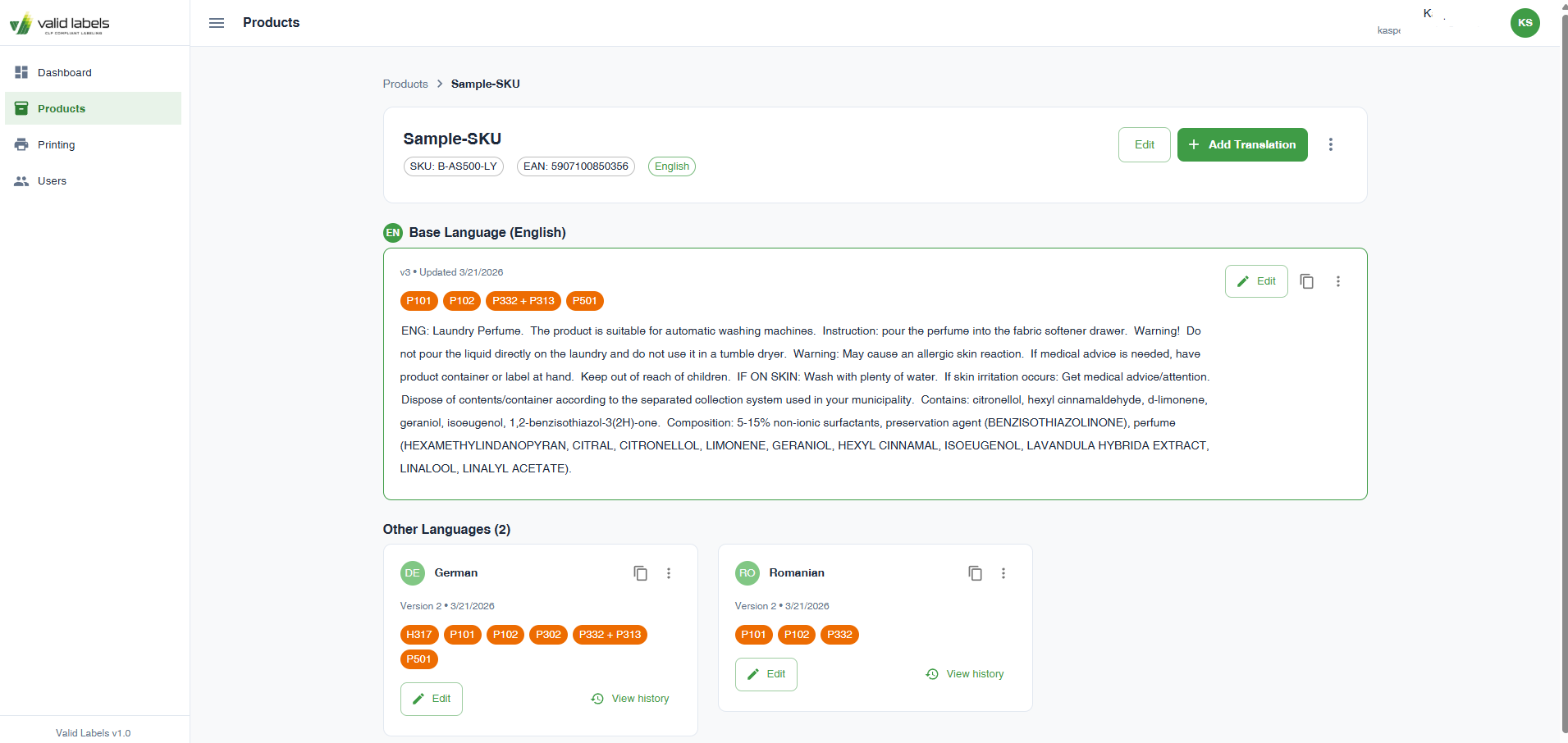 Valid Labels CLP labeling software dashboard showing label generation workflow
Best for: Fast and scalable CLP label generation workflows
Valid Labels is a modern platform designed specifically to simplify CLP labeling operations for chemical companies. Unlike many traditional compliance systems that prioritize configurability over usability, Valid Labels is built around speed, multilingual support, and practical workflow automation.
The platform handles:
- CLP-compliant label generation
- multilingual label management
- template organisation
- simplified label updates across product portfolios
One of its core design principles is keeping the compliance workflow accessible. Teams can generate and maintain labels without complex enterprise infrastructure or long implementation cycles. This makes it particularly well-suited for chemical manufacturers, private label producers, distributors, and businesses managing frequent product updates across EU markets.
Strengths:
- Modern, intuitive interface
- Strong CLP workflow focus
- Faster onboarding than enterprise systems
- Well-suited for multilingual labeling
Limitations:
- Less focused on broader EHS ecosystems
- More specialized than some large enterprises require
2. Loftware NiceLabel
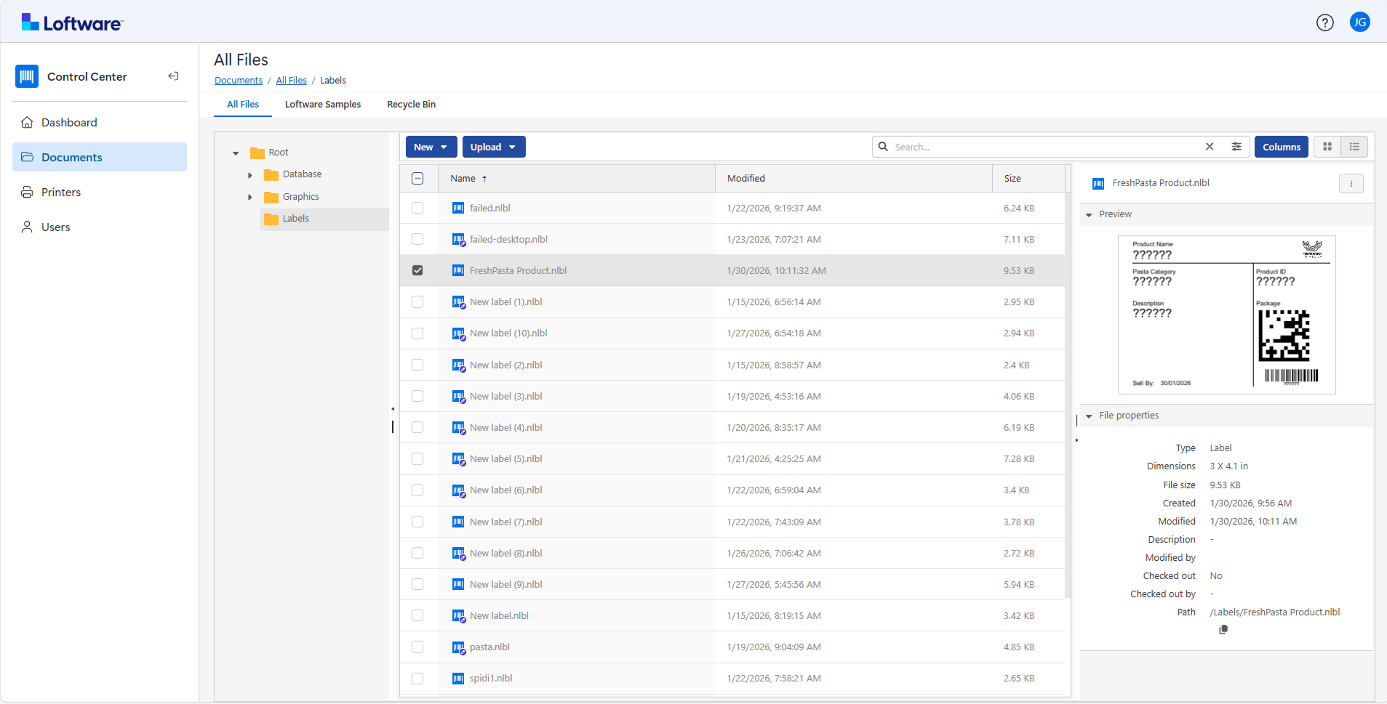 Loftware NiceLabel enterprise labeling software interface
Best for: Enterprise chemical labeling infrastructure
Loftware NiceLabel is one of the most established enterprise labeling platforms on the market. For chemical companies, it can support CLP and GHS requirements while offering strong scalability for larger organizations managing multiple facilities, users, and printing environments.
Strengths:
- Enterprise-grade scalability
- Strong ERP and system integrations
- Advanced print management
- Mature workflow approval capabilities
Limitations:
- Higher implementation complexity
- Longer onboarding process
- Often excessive for smaller or mid-sized businesses
3. NextSDS CLP Widget
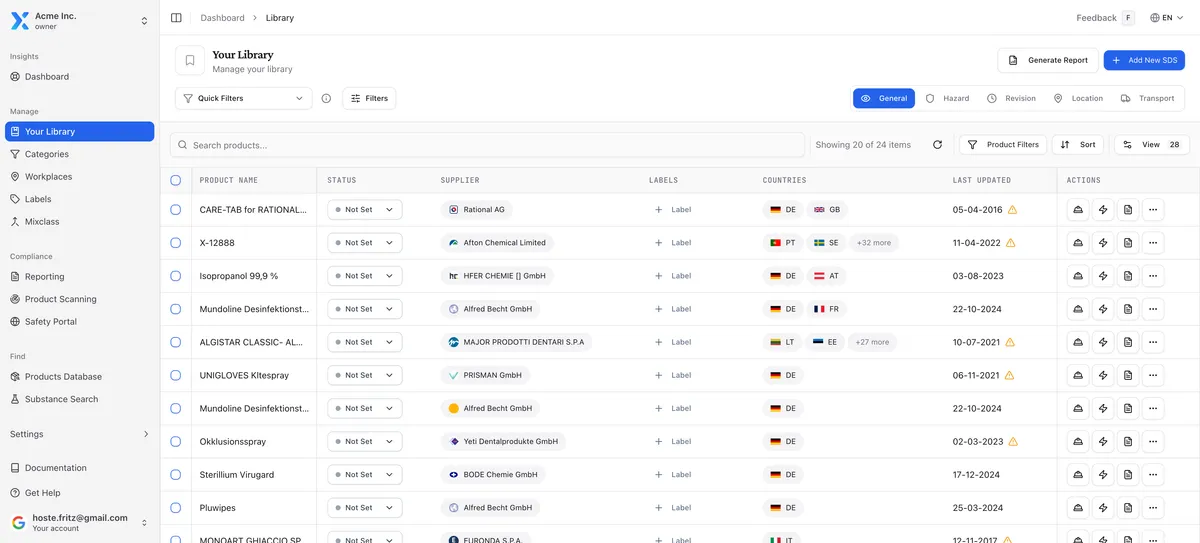 NextSDS CLP Widget for chemical label generation
Best for: Lightweight CLP label generation connected to SDS workflows
NextSDS offers a CLP Widget that generates compliant labels alongside broader SDS and safety documentation workflows. It is particularly useful for organizations already managing Safety Data Sheets and looking for a straightforward way to connect SDS information with CLP labeling requirements.
Strengths:
- CLP-focused functionality
- Integrated SDS workflow connection
- Easier onboarding than enterprise suites
- Good fit for smaller compliance teams
Limitations:
- Less customizable than enterprise systems
- Narrower workflow scope
- More compliance-oriented than packaging-oriented
4. EQGEST CLP Labelling
Best for: Manufacturing and ERP-integrated labeling workflows
EQGEST offers a CLP Labelling module integrated into its broader ERP and manufacturing ecosystem. Its strength lies in operational integration rather than standalone regulatory specialization. For businesses already working within manufacturing-focused systems, EQGEST can streamline day-to-day labeling processes.
Strengths:
- Strong manufacturing system integration
- Production workflow support
- Traceability-focused approach
- Centralised operational management
Limitations:
- Less specialized in regulatory automation
- More ERP-focused than compliance-focused
- Best suited to businesses already in the EQGEST ecosystem
5. OpenBrand
Best for: Collaborative packaging and product labeling workflows
OpenBrand focuses on product data management and collaborative packaging workflows. The platform is designed to centralise product assets and improve coordination between teams managing branding, packaging, and labeling. For chemical businesses, it can support parts of the labeling workflow where packaging consistency and cross-team collaboration matter.
Strengths:
- Strong collaboration workflows
- Centralised product information management
- Modern user experience
Limitations:
- Less specialized in CLP compliance automation
- May require additional regulatory tools for advanced compliance workflows
6. BarTender by Seagull Scientific
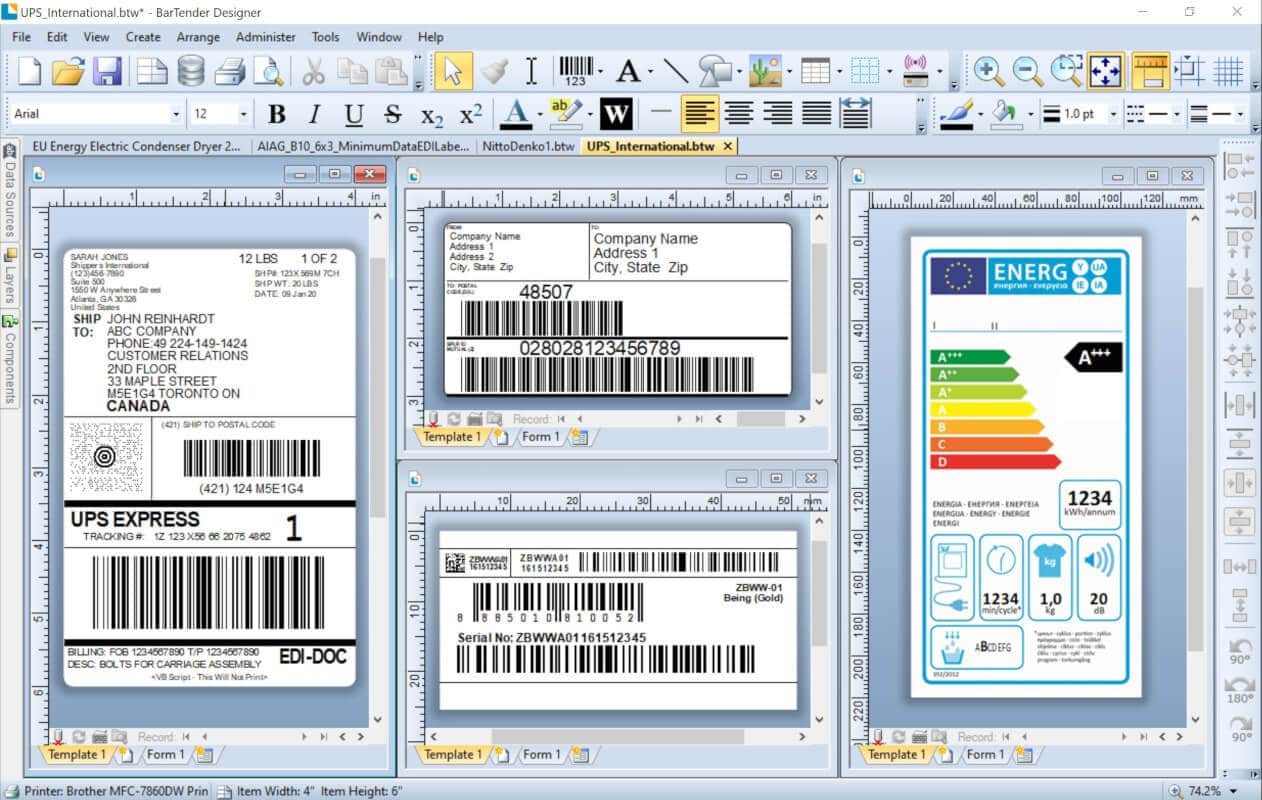 BarTender industrial labeling and barcode software dashboard
Best for: Industrial printing and barcode-heavy labeling environments
BarTender is widely recognized in manufacturing and industrial printing environments. It can be adapted for CLP labeling workflows but is not designed as a chemical compliance platform. Most organizations use it alongside separate regulatory or SDS systems.
Strengths:
- Excellent print automation
- Strong industrial printer compatibility
- Reliable large-scale deployment
Limitations:
- Limited CLP-specific specialization
- Requires additional compliance workflows
- More printing-focused than regulatory-focused
Which CLP Labeling Software Is Best?
The right solution depends on company size, regulatory complexity, labeling volume, multilingual requirements, and integration needs.
Smaller and mid-sized chemical businesses typically benefit most from platforms that prioritize usability, speed, multilingual workflows, and lower operational overhead. The priority is reducing friction in daily compliance operations, not building enterprise infrastructure.
Larger organizations typically require ERP integrations, approval workflows, centralized governance, and broader EHS ecosystems. For these businesses, enterprise platforms like Loftware NiceLabel or BarTender may be appropriate complements to specialist compliance tooling.
In practice, many companies still manage labels using spreadsheets, copied templates, and disconnected translations — workflows that are slow, error-prone, and difficult to audit. Modern CLP labeling software reduces these inefficiencies while lowering compliance risk.
What to Consider Before Choosing
Before selecting a platform, it helps to clarify:
- how frequently labels change
- how many languages are required
- whether SDS integration is necessary
- who manages compliance internally
- how many SKUs need to be maintained
- whether labels need to be print-ready at output
- how much workflow customization is actually needed
A platform designed for multinational corporations may be unnecessarily complex for smaller manufacturers. At the same time, lightweight solutions may not provide the governance and integrations required by enterprise organizations. The best long-term solution is usually the one that reduces operational friction while remaining flexible enough to adapt to regulatory changes.
Final Thoughts
CLP labeling is no longer just a packaging task. For many chemical companies, it has become a critical operational workflow that directly impacts compliance, scalability, and efficiency.
For companies looking primarily to simplify and accelerate their chemical labeling workflow, focused platforms such as Valid Labels offer a more modern and practical approach than most traditional enterprise systems. For larger organizations with complex infrastructure requirements, broader platforms like Loftware NiceLabel or industrial printing solutions like BarTender remain relevant choices.
The key is choosing software that matches the actual complexity of your workflow — not simply the largest feature list.
FAQ
What is CLP labeling software? CLP labeling software helps chemical companies generate compliant labels according to EU CLP Regulation (EC) No 1272/2008, including hazard pictograms, H-statements, P-statements, supplier details, and multilingual language requirements.
What is the difference between CLP and GHS labeling? GHS is the global hazard communication framework developed by the UN. CLP is the EU implementation of GHS. CLP defines specific label elements required for chemicals placed on the EU market.
Can CLP labels be generated automatically? Yes. Modern chemical labeling platforms can automate CLP label generation using product data and SDS information. Automation reduces manual errors and speeds up label updates across product portfolios.
Which CLP labeling software is best for small chemical companies? Smaller companies typically benefit most from tools that prioritize ease of use, multilingual workflows, and simplified compliance management — rather than enterprise infrastructure built for large-scale deployments.
Kasper Stasiak
Founder, ValidLabels
Kasper Stasiak founded ValidLabels after working directly with European chemical exporters on CLP compliance workflows. ValidLabels is built by Awakast P.S.A., based in Wrocław, Poland.
Related articles
CLP Compliance
How to Launch a CLP-Regulated Product in a New EU Market
Expanding a chemical product into another EU country? Learn what to check before launch, from CLP labels and languages to UFI and poison centre notifications.
CLP Compliance
Multilingual CLP Labels: 5 Options for Selling Across Europe
Compare five ways to manage multilingual CLP labels across Europe, including single-language, multilingual, fold-out, overlay and print-on-demand labels.