
In this article
- What Is a CLP Language Sticker?
- What Does CLP Require?
- When Can a Language Sticker Be a Good Option?
- The Biggest Risk: Version Control
- Language Sticker or a Different Label Format?
- So, Can You Use a Language Sticker for CLP Labelling?
When selling a chemical product in another EU country, creating entirely new packaging is not always practical. A common alternative is to add a language sticker, also known as an overlay label, with the required CLP information in the local language.
But is this allowed under the CLP Regulation?
In many cases, yes — provided the final label on the product meets all applicable CLP requirements.
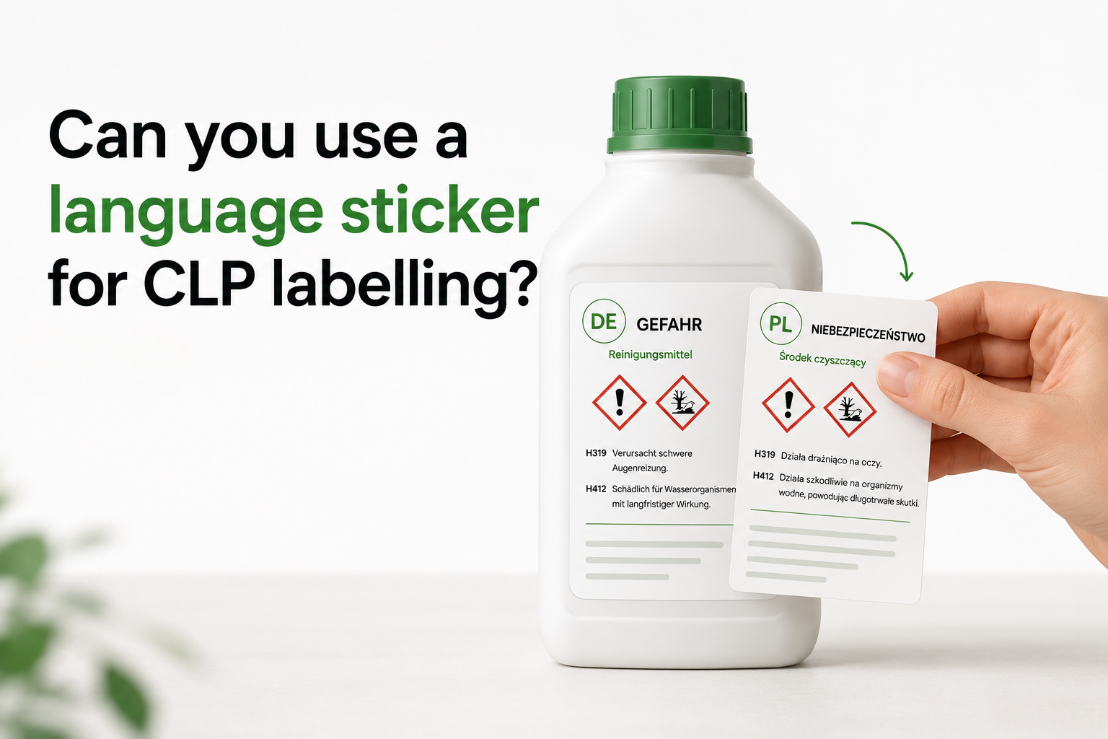 Language overlay sticker with local CLP information applied to a chemical product
What Is a CLP Language Sticker?
A language sticker is an additional label applied to existing packaging to provide mandatory information in the language required by the target market.
For example, a product originally labelled in German could receive an additional Polish-language label before being placed on the Polish market.
This approach can be particularly useful for:
- entering a new EU market;
- smaller production runs;
- imported products; and
- testing demand before creating dedicated packaging.
What Does CLP Require?
Under the CLP Regulation, mandatory label information generally needs to be provided in the official language or languages of the Member State where the product is placed on the market, unless that Member State provides otherwise.
Using a sticker does not remove any of these obligations.
The final labelling must still contain the required elements applicable to the product, such as:
- product identifiers;
- supplier information;
- hazard pictograms;
- signal words;
- hazard and precautionary statements;
- supplemental information; and
- UFI, where required.
When Can a Language Sticker Be a Good Option?
Overlay labels can make sense when a company wants to sell an existing product in another country without producing a separate packaging version.
Instead of maintaining pre-printed packaging for every market, the appropriate language version can be applied before distribution.
However, the sticker must not make the final label misleading, illegible or inconsistent. It should also remain securely attached and meet the applicable CLP requirements for label presentation.
The Biggest Risk: Version Control
The difficult part is often not printing the sticker. It is making sure the correct version reaches the correct product and market.
If you manage dozens of products across several countries, one outdated translation or incorrect label version can create a compliance problem.
This is why language overlay labels work best when label content, translations and versions are managed centrally.
Valid Labels helps companies manage multilingual CLP label versions and generate the right label for each product and market.
Language Sticker or a Different Label Format?
A sticker is only one option.
Depending on your volumes, number of markets and available packaging space, a single-language, multilingual, fold-out or print-on-demand label may be more practical. Compare the main approaches in our guide to multilingual CLP labels.
For a broader overview of CLP requirements and upcoming regulatory changes, see our CLP Regulation Guide.
So, Can You Use a Language Sticker for CLP Labelling?
Yes, a language sticker can be used as part of a CLP labelling strategy, as long as the product's final labelling fully complies with the applicable CLP requirements in the country where it is sold.
For companies expanding across Europe, overlay labels can provide a flexible alternative to producing separate packaging for every market — but only when translations, regulatory data and label versions are carefully controlled.
Nikola Kopczyńska
Content Specialist, ValidLabels
Kasper Stasiak founded ValidLabels after working directly with European chemical exporters on CLP compliance workflows. ValidLabels is built by Awakast P.S.A., based in Wrocław, Poland.
Related articles
CLP Compliance
How to Launch a CLP-Regulated Product in a New EU Market
Expanding a chemical product into another EU country? Learn what to check before launch, from CLP labels and languages to UFI and poison centre notifications.
CLP Compliance
Multilingual CLP Labels: 5 Options for Selling Across Europe
Compare five ways to manage multilingual CLP labels across Europe, including single-language, multilingual, fold-out, overlay and print-on-demand labels.