
In this article
- 1. Single-Language Label
- 2. Multilingual Label
- 3. Fold-Out Label
- 4. Language Overlay Label
- 5. Print-on-Demand Label
- What About Digital CLP Labels?
- Which CLP Labelling Option Should You Choose?
Selling the same chemical product across several European markets creates a practical challenge: how do you provide the required CLP information in the right languages without creating an unmanageable number of labels?
Under the CLP Regulation, mandatory label information must generally appear in the official language or languages required by the Member State where the product is placed on the market.
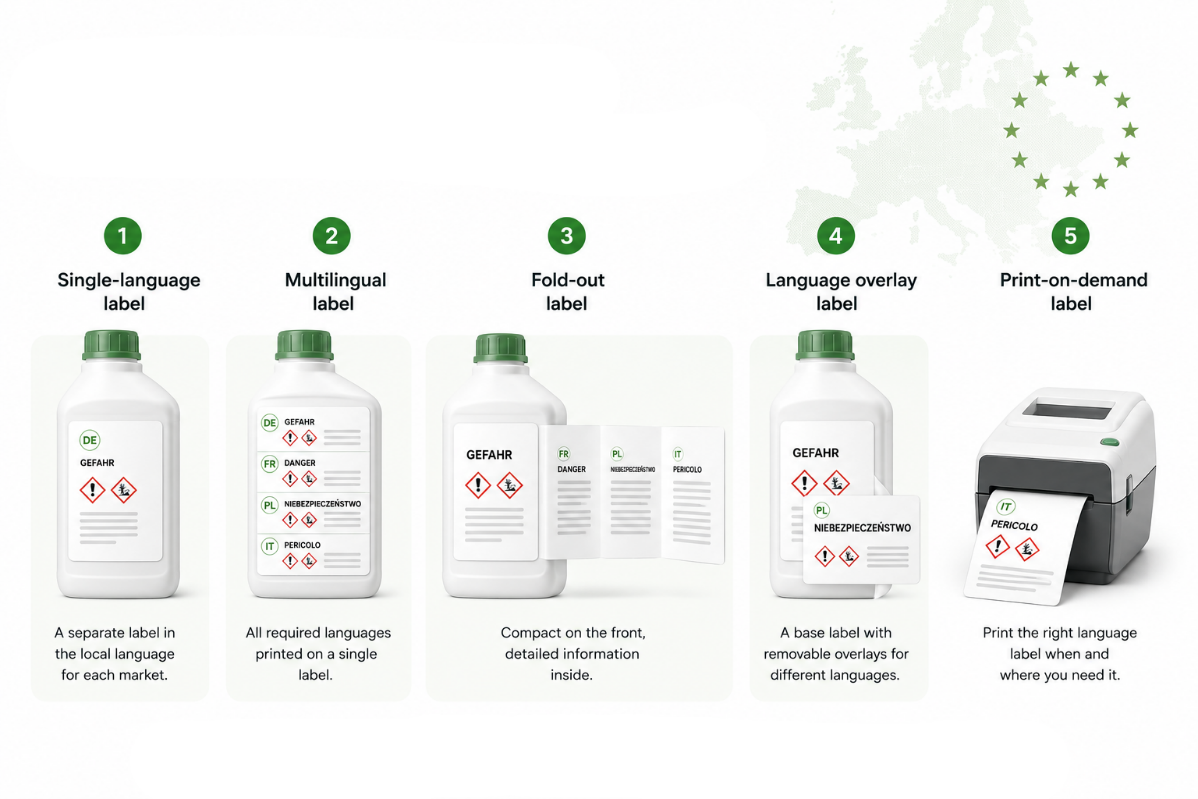 Five options for managing multilingual CLP labels across European markets
Here are five common ways to manage CLP labels across multiple European markets.
1. Single-Language Label
The simplest option is a separate label for each market.
A product sold in Germany gets a German label, while the same product sold in Poland gets a Polish version.
Best for: high sales volumes in individual markets.
Main challenge: every additional country means another label version and potentially separate packaging inventory.
2. Multilingual Label
A multilingual label includes several languages on the same packaging.
This reduces the number of market-specific versions and can simplify inventory management. The main limitation is space: all mandatory information still needs to remain clear and legible.
Best for: products sold across several markets where packaging provides enough space.
3. Fold-Out Label
Fold-out labels provide additional space for regulatory information without significantly increasing the footprint of the label on the packaging.
They can be useful when a product requires extensive hazard information in several languages.
Best for: products sold in many countries or with large amounts of mandatory information.
Main challenge: they can be more complex and expensive to produce than standard labels.
4. Language Overlay Label
A language overlay label adds market-specific information to existing packaging, usually in the form of an additional label or sticker.
This can be particularly useful when entering a new market without producing an entirely new packaging run. Read more about this approach in our guide to language stickers for CLP labelling.
Best for: testing new markets, smaller volumes and short production runs.
Main challenge: companies need strong version control to ensure the correct label is applied to the correct product and market.
5. Print-on-Demand Label
Instead of keeping large inventories of pre-printed labels, companies can generate and print the required language version when it is needed.
This makes it easier to serve multiple markets without maintaining separate stocks of packaging for every country.
Best for: companies with many products, markets or variable order volumes.
Main challenge: label data and templates need to be carefully controlled so that the correct version is always printed.
What About Digital CLP Labels?
The revised CLP Regulation also introduces digital labelling. However, digital labels do not replace the physical label entirely. Only certain information can be provided exclusively in digital form.
You can learn more about digital labelling and other upcoming changes in our CLP Regulation Guide.
Which CLP Labelling Option Should You Choose?
There is no single solution that works for every chemical company.
A business selling large volumes in two countries may prefer single-language labels. A company operating across ten markets may benefit more from multilingual or fold-out labels, while businesses with changing volumes may find print-on-demand more efficient.
Whatever approach you choose, the real challenge is keeping every product, language and market version accurate and up to date.
Valid Labels helps companies create and manage multilingual CLP labels from one centralised workflow, making it easier to scale chemical products across European markets.
One product. Multiple markets. Fewer labels to manage.
Nikola Kopczyńska
Content Specialist, ValidLabels
Kasper Stasiak founded ValidLabels after working directly with European chemical exporters on CLP compliance workflows. ValidLabels is built by Awakast P.S.A., based in Wrocław, Poland.
Related articles
CLP Compliance
How to Launch a CLP-Regulated Product in a New EU Market
Expanding a chemical product into another EU country? Learn what to check before launch, from CLP labels and languages to UFI and poison centre notifications.
CLP Compliance
Can You Use a Language Sticker for CLP Labelling?
Can you use a language sticker for CLP labelling in the EU? Learn when overlay labels can work, what information they must contain and what to check before selling.