
In this article
- 1. Confirm the Product Classification
- 2. Prepare the Correct Language Version
- 3. Check UFI and Poison Centre Notification Requirements
- 4. Create and Validate the New CLP Label
- 5. Don't Forget Online Sales
- Before Entering a New EU Market
Expanding into another EU country may seem simple because the CLP Regulation applies across the European Union. In practice, however, launching the same chemical product in a new market often requires additional compliance work.
Language requirements, CLP labels and poison centre notifications all need to be checked before the product reaches customers.
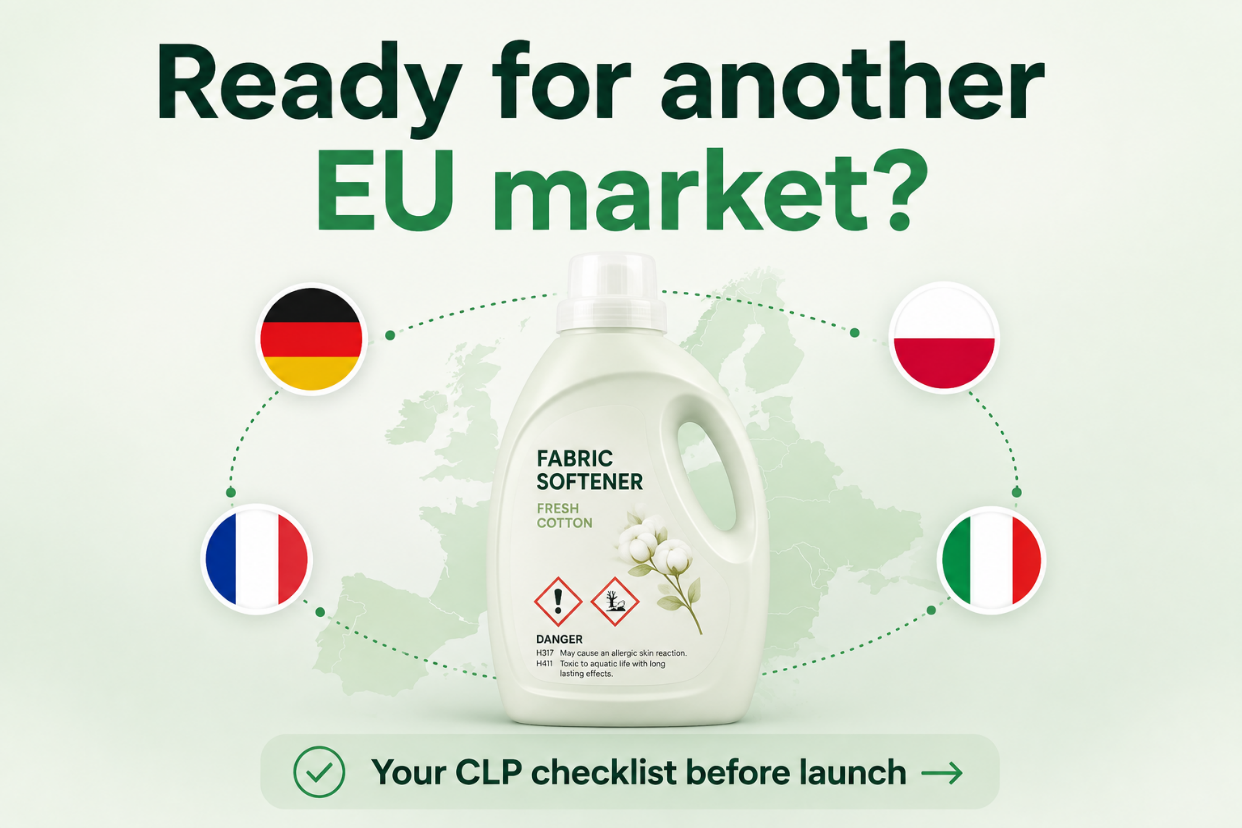 CLP-regulated chemical product ready for launch in a new EU market
Here are the key steps.
1. Confirm the Product Classification
Start with the current classification of the substance or mixture.
The classification determines the required CLP label elements, including hazard pictograms, signal words, hazard statements and precautionary statements.
Before creating another market version, make sure you are working from the latest regulatory data and Safety Data Sheet (SDS).
2. Prepare the Correct Language Version
CLP labels generally need to use the official language or languages of the Member State where the product is placed on the market, unless that country provides otherwise.
Entering Germany, France and Poland can therefore mean maintaining several versions of the same label.
This becomes increasingly difficult as the number of products and markets grows.
Valid Labels helps companies create and manage multilingual CLP labels without preparing every market version manually.
3. Check UFI and Poison Centre Notification Requirements
For hazardous mixtures subject to Annex VIII of CLP, entering another Member State can also affect poison centre notification (PCN) requirements.
Before launch, verify that:
- the target Member State is covered by the relevant notification;
- the correct UFI is linked to the mixture;
- relevant trade names are included; and
- the required information is provided in the appropriate language.
ECHA allows multimarket submissions, but requirements such as accepted languages and fees can differ between Member States.
This step is particularly important for distributors expanding an existing product into additional EU markets.
4. Create and Validate the New CLP Label
Once the regulatory requirements are confirmed, prepare the market-specific label.
Check that the required product identifiers, supplier information, UFI where applicable, pictograms, signal word, H-statements, P-statements and supplemental information are correct.
The challenge is not usually creating one new label. It is keeping dozens or hundreds of market-specific versions consistent when product data changes.
With Valid Labels, regulatory data can be used to generate multilingual CLP labels and manage different product versions from one workflow.
5. Don't Forget Online Sales
If the product will also be sold online, your e-commerce offer may need additional CLP information.
Our dedicated CLP product-page checklist explains what businesses should prepare for the revised CLP distance-selling requirements applying from 1 January 2028.
Before Entering a New EU Market
A CLP-compliant product in one EU country is not automatically ready to launch unchanged in another.
Before expansion, check:
- classification and SDS;
- local language requirements;
- UFI and PCN coverage where applicable;
- the market-specific CLP label; and
- additional product-specific or national requirements.
For businesses selling across multiple European markets, managing these elements manually quickly becomes difficult.
Valid Labels helps chemical companies create, translate and manage CLP labels across EU markets — making international expansion easier to scale.
Nikola Kopczyńska
Content Specialist, ValidLabels
Kasper Stasiak founded ValidLabels after working directly with European chemical exporters on CLP compliance workflows. ValidLabels is built by Awakast P.S.A., based in Wrocław, Poland.
Related articles
CLP Compliance
Multilingual CLP Labels: 5 Options for Selling Across Europe
Compare five ways to manage multilingual CLP labels across Europe, including single-language, multilingual, fold-out, overlay and print-on-demand labels.
CLP Compliance
Can You Use a Language Sticker for CLP Labelling?
Can you use a language sticker for CLP labelling in the EU? Learn when overlay labels can work, what information they must contain and what to check before selling.