
In this article
- Manufacturer
- Importer and Distributor
- Private Label Brand Owner
- Who Is Responsible When Entering a New EU Market?
- CLP Responsibility at a Glance
- Managing CLP Responsibilities Across Europe
One of the most common misconceptions about CLP compliance is that the manufacturer is always responsible for all product labelling and documentation.
In reality, responsibilities depend on the role your company plays in the supply chain.
Under the CLP Regulation, manufacturers, importers and distributors can all have responsibilities for ensuring that hazardous chemical products are correctly labelled before being placed or made available on the EU market.
Manufacturer
The manufacturer is responsible for product classification, CLP-compliant labelling and providing the required product information.
This typically includes ensuring that:
- the product is correctly classified;
- the CLP label contains the required information;
- the Safety Data Sheet (SDS) is up to date where required; and
- relevant information is provided to customers.
When the product is sold in another EU country, documentation and labelling may also need to be adapted to the language requirements of the destination market.
Importer and Distributor
An importer places products from outside the EU on the EU market, while a distributor makes products available within the EU.
Both need to ensure that the products they supply comply with the applicable regulatory requirements, including correct CLP labelling and up-to-date documentation.
This becomes particularly important when expanding into another EU market.
For example, a manufacturer may provide an SDS and label that are suitable for one country but not for the destination market. In such cases, the importer or distributor needs to ensure that the documentation and labelling meet the requirements of the market where the product will be sold.
Private Label Brand Owner
A private label brand owner sells products under its own brand, but “private label brand owner” does not by itself define the company's legal role under CLP.
The company's responsibilities depend on whether it acts as a manufacturer, importer or distributor.
If your business sells private label chemical products, it is therefore important to establish your role in the supply chain and the obligations that come with it, including product labelling and documentation.
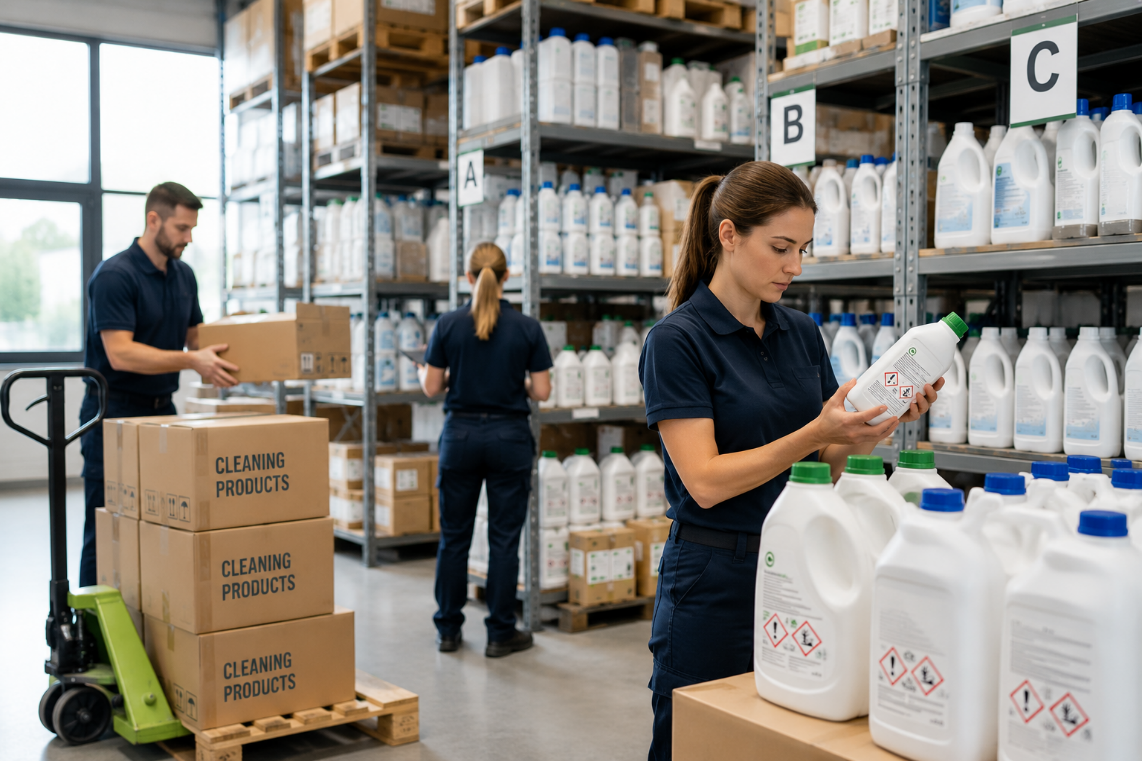 Warehouse workers checking CLP-labelled chemical products in the EU supply chain
Who Is Responsible When Entering a New EU Market?
A product that is compliant in one Member State may still require changes before being sold in another.
The classification will often remain unchanged, but the label language and supporting documentation may need to be adapted for the destination market.
Before placing the product on a new market, check:
- the latest SDS and its language version;
- consistency between the SDS and product label;
- the required market language;
- all applicable CLP label elements;
- UFI, where required; and
- consistency of the product name and intended use across documentation.
CLP Responsibility at a Glance
| Role | Key responsibility |
|---|---|
| Manufacturer | Classification, SDS, CLP labelling and required product information |
| Importer | Ensuring products entering the EU comply with applicable CLP requirements |
| Distributor | Ensuring products supplied within the EU have compliant labelling and up-to-date documentation |
| Private label brand owner | Responsibilities depend on whether the company acts as a manufacturer, importer or distributor |
Managing CLP Responsibilities Across Europe
Responsibility for CLP compliance does not always sit with one company — or one department.
When products are sold across several markets, regulatory, sales, e-commerce, marketing and operations teams may all work with the same product information.
This makes having a single source of truth increasingly important.
Valid Labels helps companies centralise product data and manage CLP labels across products, languages and markets, reducing the risk of outdated or inconsistent information.
For a broader overview of CLP requirements when expanding across Europe, see our CLP Regulation Guide.
Nikola Kopczyńska
Content Specialist, ValidLabels
Kasper Stasiak founded ValidLabels after working directly with European chemical exporters on CLP compliance workflows. ValidLabels is built by Awakast P.S.A., based in Wrocław, Poland.
Related articles
CLP Compliance
How to Launch a CLP-Regulated Product in a New EU Market
Expanding a chemical product into another EU country? Learn what to check before launch, from CLP labels and languages to UFI and poison centre notifications.
CLP Compliance
Multilingual CLP Labels: 5 Options for Selling Across Europe
Compare five ways to manage multilingual CLP labels across Europe, including single-language, multilingual, fold-out, overlay and print-on-demand labels.