
In this article
- UFI Code - Quick Overview
- What Is a UFI Code?
- When Is a UFI Code Required?
- Where Should the UFI Code Be Placed?
- How to Generate a UFI Code
- UFI Code vs Product Identifier
- UFI and CLP Labeling Requirements
- Common UFI Mistakes
- UFI and Multilingual Labeling
- How to Manage UFI Codes at Scale
- UFI in the Labeling Workflow
- Why UFI Compliance Matters
- Key Takeaways
- FAQ
If you are placing chemical products on the EU market, you may be required to include a UFI code on your label.
For many companies, this requirement is confusing at first. It is not just another identifier - it plays a key role in emergency response and regulatory compliance.
In this guide, you will learn what a UFI code is, when it is required, and how to use it correctly.
UFI Code - Quick Overview
A UFI (Unique Formula Identifier) is a 16-character code required for hazardous mixtures under EU CLP regulations.
In short, it:
- uniquely identifies a product's formulation
- connects the product to poison centre notifications
- must be included on the CLP label
- is required before placing products on the EU market
What Is a UFI Code?
A UFI code is part of the EU poison centre notification (PCN) system and is required for CLP compliance across EU markets.
Its purpose is simple. In case of an emergency, poison centres must be able to quickly identify the exact composition of a product.
Instead of relying only on product names or labels, authorities use the UFI code to access detailed information submitted by the supplier. This improves hazard communication and ensures faster and more accurate medical response.
What Does a UFI Code Look Like?
A UFI code consists of 16 characters divided into blocks.
Example: UFI: 8F2K-4J9L-1234-ABCD
It is generated using:
- your company's VAT number or company identifier
- an internal formulation number
When Is a UFI Code Required?
A UFI code is required when a product meets specific conditions under CLP regulations.
You must include a UFI if:
- the product is classified as a hazardous mixture
- the product is placed on the EU market
- a poison centre notification is required
You do NOT need a UFI if:
- the product is not classified as hazardous
- it is used only for research and development
- it is not supplied to the general public or professionals in some cases
Where Should the UFI Code Be Placed?
The UFI must appear on the CLP label.
Placement rules:
- clearly visible and legible
- close to other label elements
- not hidden or separated from hazard information
In some cases, the UFI may also appear in the Safety Data Sheet (SDS).
How to Generate a UFI Code
Generating a UFI is a structured process.
Step by step:
- Identify your company using a VAT number or equivalent identifier.
- Assign an internal formulation number.
- Use the official UFI generator provided by ECHA.
- Generate the UFI code.
- Include it in your PCN submission.
- Place it on your label.
UFI Code vs Product Identifier
A UFI code is often confused with a product identifier, but they serve different purposes.
- The product identifier describes the product, such as its name or CAS number.
- The UFI code links the formulation to poison centre data.
Both may be required for a compliant CLP label.
UFI and CLP Labeling Requirements
The UFI code is one of the mandatory elements of a CLP label for many hazardous mixtures.
A compliant label typically includes:
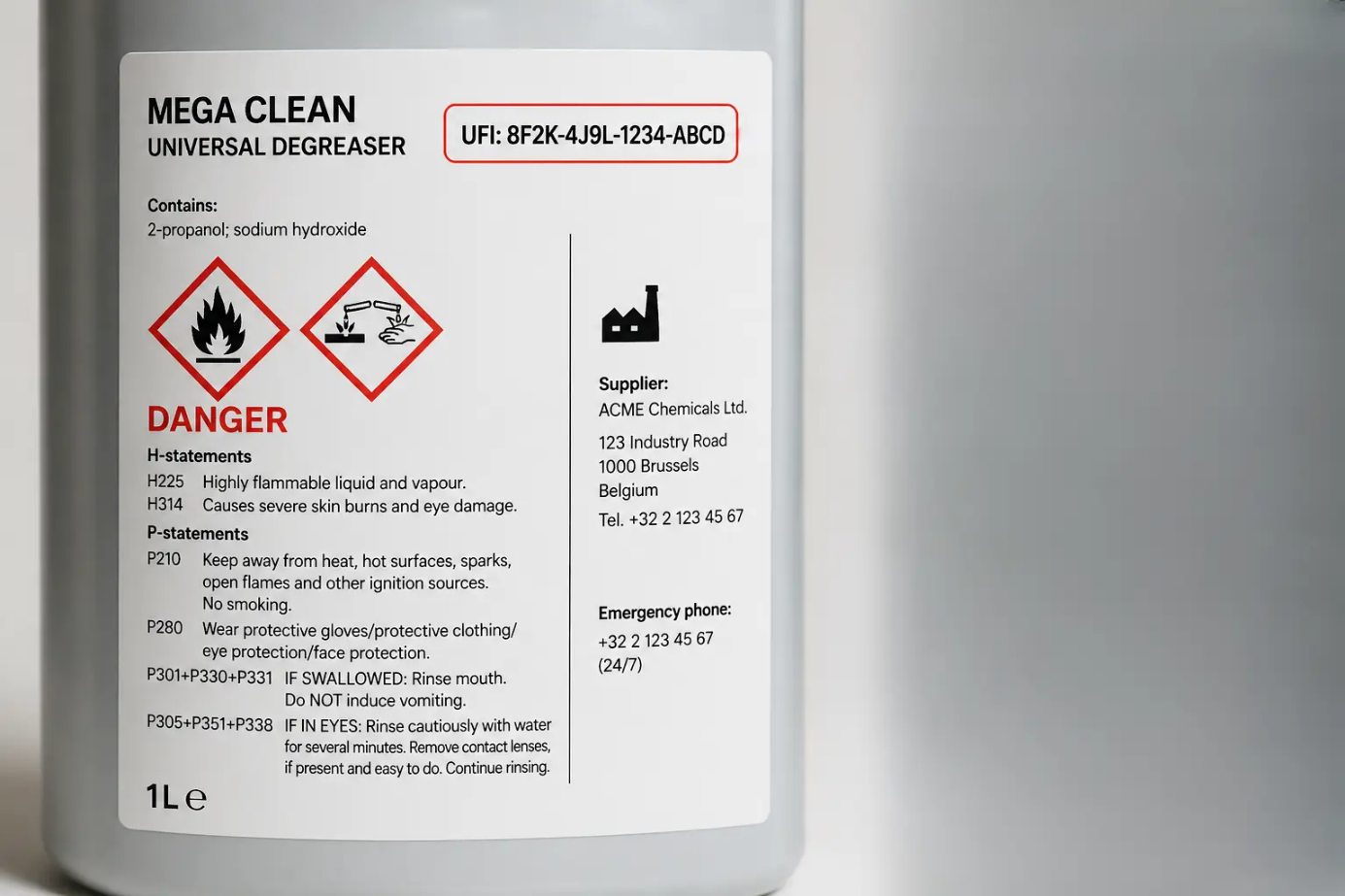 CLP label example with the UFI code highlighted as a required element
- product identifier
- hazard pictograms
- signal word
- hazard statements
- precautionary statements
- supplier details
- UFI code
The example above shows how a UFI code appears as part of a CLP-compliant label. Missing the UFI when required results in non-compliance.
Common UFI Mistakes
This is where many companies encounter problems.
Many of these issues are similar to broader CLP labeling mistakes that can delay shipments and cause compliance issues.
Typical issues:
- forgetting to include the UFI on the label
- using an incorrect or outdated UFI
- mismatching the UFI with the formulation
- failing to update the UFI after formulation changes
These errors can lead to:
- regulatory issues
- delayed product launches
- shipment delays
UFI and Multilingual Labeling
When selling across multiple EU markets, UFI management becomes more complex.
Even though the UFI itself does not change between languages, you still need to:
- ensure it appears correctly on every label version
- maintain consistency across all SKUs and markets
This is part of broader multilingual label compliance, where even small inconsistencies can create risks.
How to Manage UFI Codes at Scale
Managing a few products is straightforward. Managing hundreds or thousands is not.
Challenges include:
- tracking multiple formulations
- maintaining version control
- ensuring correct UFI placement
- aligning labels with PCN submissions
While UFI codes are generated separately as part of the PCN process, tools like Valid Labels help teams apply UFI codes consistently across CLP labels and reduce the risk of operational errors.
UFI in the Labeling Workflow
UFI is not a standalone element - it is part of the overall labeling process.
Typical workflow:
- SDS preparation
- Hazard classification
- UFI generation
- PCN submission
- Label creation
- Translation and validation
- Printing and packaging
To see how labeling workflows can be streamlined in practice, you can explore how CLP labeling workflows can be automated.
Why UFI Compliance Matters
The UFI system is designed to improve safety and traceability.
Without proper implementation:
- emergency response becomes less effective
- regulatory risk increases
- compliance audits become more difficult
As regulations evolve, UFI will continue to be a critical part of EU chemical compliance.
Key Takeaways
- A UFI code is required for many hazardous mixtures in the EU.
- It links products to poison centre notifications.
- It must appear on the CLP label when required.
- Incorrect or missing UFI information can lead to compliance issues.
- Managing UFI codes at scale requires structured processes.
As your product range grows, managing UFI codes manually becomes increasingly difficult. Valid Labels helps manage CLP labels at scale and ensures required elements are correctly included across all markets.
If you manage multiple products or EU markets, it is worth seeing how labeling and UFI management can be automated in practice.
FAQ
What does UFI stand for?
Unique Formula Identifier.
Is a UFI required for all products?
No, only for hazardous mixtures that fall within the relevant PCN requirements.
Does the UFI change for each country?
No. The UFI remains the same across EU markets.
What happens if the UFI is missing?
The product may be considered non-compliant and should not be legally placed on the market.
Nikola Kopczyńska
Content Specialist, ValidLabels
Kasper Stasiak founded ValidLabels after working directly with European chemical exporters on CLP compliance workflows. ValidLabels is built by Awakast P.S.A., based in Wrocław, Poland.
Related articles
CLP Compliance
How to Launch a CLP-Regulated Product in a New EU Market
Expanding a chemical product into another EU country? Learn what to check before launch, from CLP labels and languages to UFI and poison centre notifications.
CLP Compliance
Multilingual CLP Labels: 5 Options for Selling Across Europe
Compare five ways to manage multilingual CLP labels across Europe, including single-language, multilingual, fold-out, overlay and print-on-demand labels.