
In this article
- CLP Label – Quick Overview
- What Is a CLP Label?
- CLP Label Requirements in the EU
- CLP Label Example
- Who Needs to Comply With CLP Labeling?
- Language Requirements in the EU
- Where Do Most Errors Come From?
- How to Create a CLP Label
- Why Labeling Becomes a Bottleneck
- A More Efficient Approach
- Key Takeaways
- FAQ
If you are selling chemicals in the European Union, using a CLP label is a legal requirement.
At first glance, it may seem straightforward. Many companies struggle with what exactly needs to be included and how to stay compliant across different EU markets.
The problem often appears too late—when shipments are delayed, products are rejected, or relabeling becomes necessary.
This guide explains what CLP labeling is and how it works in practice.
CLP Label – Quick Overview
A CLP label communicates chemical hazards in a standardized way across the EU.
In short, it:
- applies to hazardous substances and mixtures
- ensures consistent safety information
- follows strict regulatory wording
- must be adapted to local languages
What Is a CLP Label?
CLP labeling is defined by the EU regulation on Classification, Labelling and Packaging (EC No 1272/2008).
Its purpose is to make hazard communication clear and consistent. Anyone handling a chemical product should immediately understand the risks and how to use it safely.
This system is part of broader EU chemical regulations, which aim to harmonize safety standards across all member states.
CLP Label Requirements in the EU
To meet CLP labeling requirements in the EU, each label must contain specific elements.
Core components:
- product identifier (e.g. chemical name, CAS number)
- hazard pictograms
- signal word such as "Danger" or "Warning"
- hazard statements (H-statements)
- precautionary statements (P-statements)
- supplier details
- UFI code for mixtures
These elements are part of a structured system of chemical labeling compliance, where both wording and formatting must follow official standards.
Even small inconsistencies can result in non-compliance.
CLP Label Example
To understand how these elements come together, consider a simple example.
Example label content:
- Product: Acetone (CAS: 67-64-1)
- Signal word: Danger
- Hazard: Highly flammable liquid and vapor
- Precaution: Keep away from heat
Managing one label is relatively simple. The complexity increases when you need to handle:
- multiple products
- multiple EU markets
- multiple language versions
At that stage, maintaining consistency becomes difficult. You can see how CLP labeling workflows are structured and automated to understand how companies handle translations, validation, and printing across multiple markets.
The diagram below shows how a typical CLP label is structured:
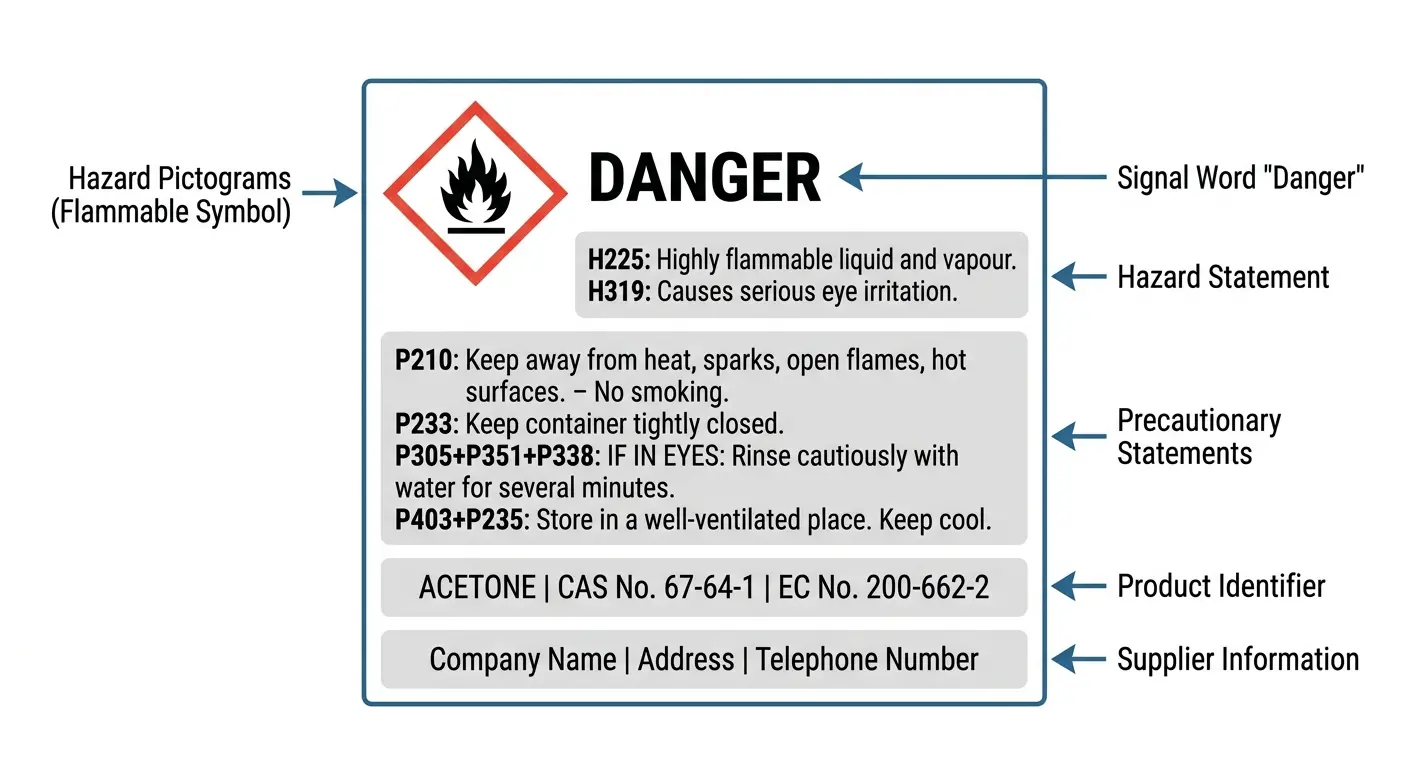 CLP label example showing hazard pictograms, signal word, hazard and precautionary statements
Who Needs to Comply With CLP Labeling?
Responsibility is shared across the supply chain.
The following groups must comply:
- Manufacturers — responsible for classification and labeling before products enter the market
- Importers — take full responsibility when bringing products into the EU
- Distributors — ensure labels remain accurate during storage and resale
- Downstream users — create labels for mixtures
- Exporters — adapt labeling to each EU market
In most organizations, this process involves multiple teams working with the same data.
Language Requirements in the EU
One of the biggest challenges is adapting labels to different markets.
Each country requires its own language:
- Germany → German
- France → French
- Poland → Polish
This is a key part of hazard communication, ensuring safety information is clearly understood locally.
As a result, companies must manage:
- multiple label versions for the same product
- strict terminology requirements
- higher risk of inconsistency
To keep this under control, many teams use tools such as the ValidLabels multilingual CLP labeling system to maintain consistency across languages.
Where Do Most Errors Come From?
This is where most companies start running into problems.
The issue is rarely the regulation itself. It's how labeling is handled in everyday operations.
Common sources of errors:
- copying content between files
- using outdated statements
- storing labels in spreadsheets
- missing version control
- selecting the wrong label during packing
Typical consequences:
- shipment delays at EU borders
- rejected goods
- manual relabeling
- additional logistics costs
Many labeling issues appear during real-world operations, especially at the packaging stage.
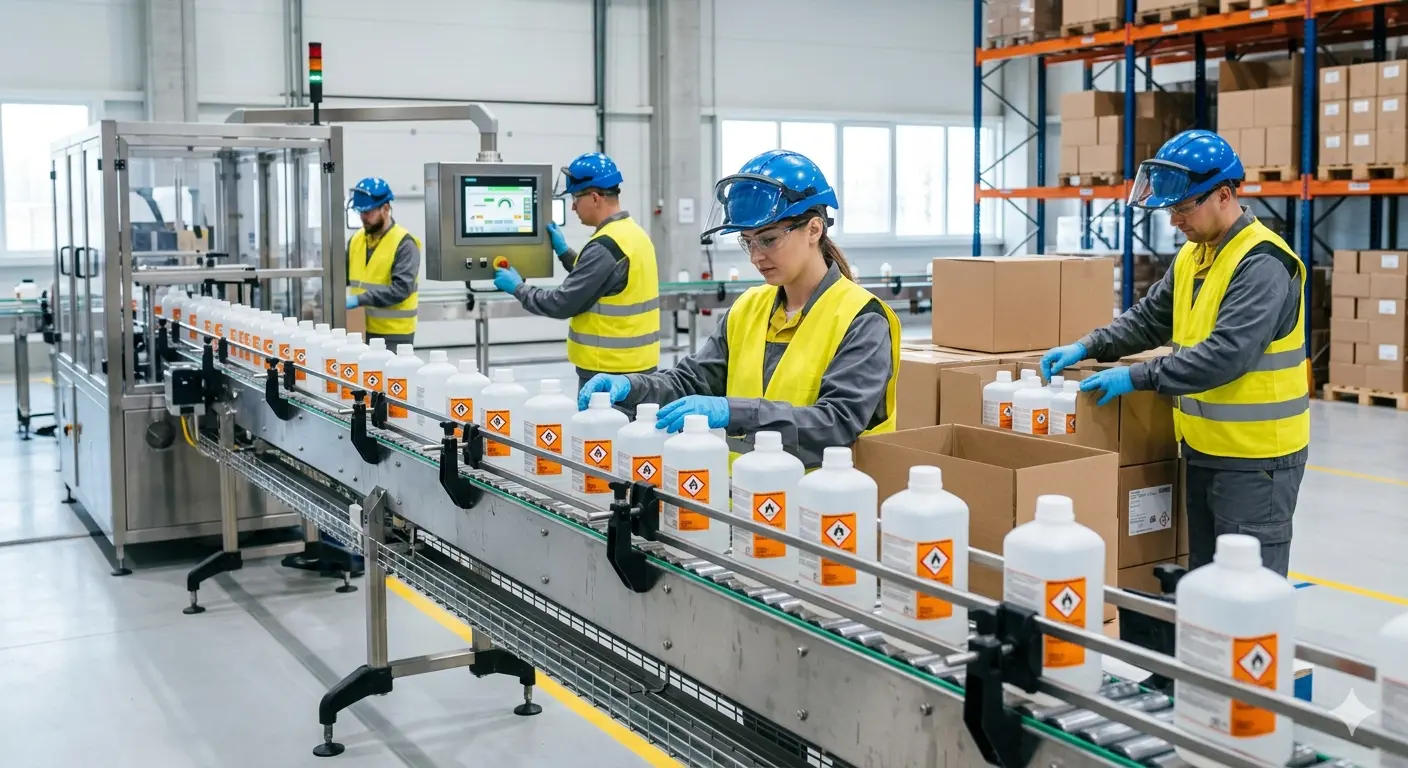 Workers applying labels to chemical products on packaging line
How to Create a CLP Label
The process follows a clear sequence.
Step-by-step:
- Get CLP Classification from manufacturer provided SDS
- Translate content into required languages
- Validate compliance
- Prepare the final label for printing
This approach works well on a small scale. As complexity grows, maintaining accuracy becomes more difficult.
To see how this process can be streamlined in practice, you can explore how CLP labeling workflows can be automated.
Why Labeling Becomes a Bottleneck
As operations scale, labeling becomes harder to manage.
Main reasons:
- growing number of SKUs
- expansion into multiple EU markets
- frequent updates
- pressure on packing speed
Manual workflows struggle to keep up. Over time, labeling becomes a bottleneck that affects the entire supply chain.
A More Efficient Approach
Companies that scale successfully introduce structured workflows.
This typically includes:
- centralizing label and SDS data
- standardizing terminology
- validating content before use
- tracking changes over time
- ensuring correct label selection during packing
Automation helps support all of these steps and reduces the risk of errors.
Key Takeaways
- CLP labeling is mandatory for hazardous chemicals in the EU
- Responsibility is shared across multiple roles
- Language requirements increase complexity
- Most issues come from manual processes
- Structured workflows improve reliability
As your product range and number of markets grow, managing labeling manually becomes increasingly difficult. You can explore how ValidLabels helps automate CLP labeling workflows and reduce errors across your operations.
If you are working with multiple SKUs or expanding into new EU markets, it is worth seeing how this process can be automated in practice.
FAQ
What does CLP stand for?
Classification, Labelling and Packaging.
Do all chemicals require CLP labels?
No, only those classified as hazardous.
Do labels need to be translated?
Yes, they must match the official language of each market.
Is manual labeling enough?
It may work initially, but becomes difficult as operations grow.
Nikola Kopczyńska
Content Specialist, ValidLabels
Kasper Stasiak founded ValidLabels after working directly with European chemical exporters on CLP compliance workflows. ValidLabels is built by Awakast P.S.A., based in Wrocław, Poland.
Related articles
CLP Compliance
How to Launch a CLP-Regulated Product in a New EU Market
Expanding a chemical product into another EU country? Learn what to check before launch, from CLP labels and languages to UFI and poison centre notifications.
CLP Compliance
Multilingual CLP Labels: 5 Options for Selling Across Europe
Compare five ways to manage multilingual CLP labels across Europe, including single-language, multilingual, fold-out, overlay and print-on-demand labels.