
In this article
- What CLP Information Should Appear on a Product Page?
- CLP Product Page Checklist
- Why Managing CLP Product Pages Manually Is Difficult
- Keep Your Online CLP Information Up to Date with Valid Labels
- Quick CLP Product Page Audit
- Prepare Your Online Store for the New CLP Requirements
Selling chemical products online in the EU involves more than adding a product name, description and price.
The revised EU CLP Regulation introduces specific requirements for distance sales of hazardous substances and mixtures. Under the new Article 48a, an online offer must clearly and visibly display the label elements required under Article 17 of the CLP Regulation.
The new requirements for distance sales will apply from 1 January 2028.
For manufacturers, distributors and online retailers, this means product pages need to be prepared for more comprehensive hazard communication.
Is your online product page ready? Use this checklist to find out.
What CLP Information Should Appear on a Product Page?
Under Article 48a, where substances or mixtures are placed on the market through distance sales, the offer must clearly and visibly indicate the applicable label elements set out in Article 17.
Depending on the product, these can include:
- the name, address and telephone number of the supplier;
- product identifiers;
- hazard pictograms;
- the applicable signal word;
- hazard statements (H-statements);
- precautionary statements (P-statements); and
- supplemental information required on the label.
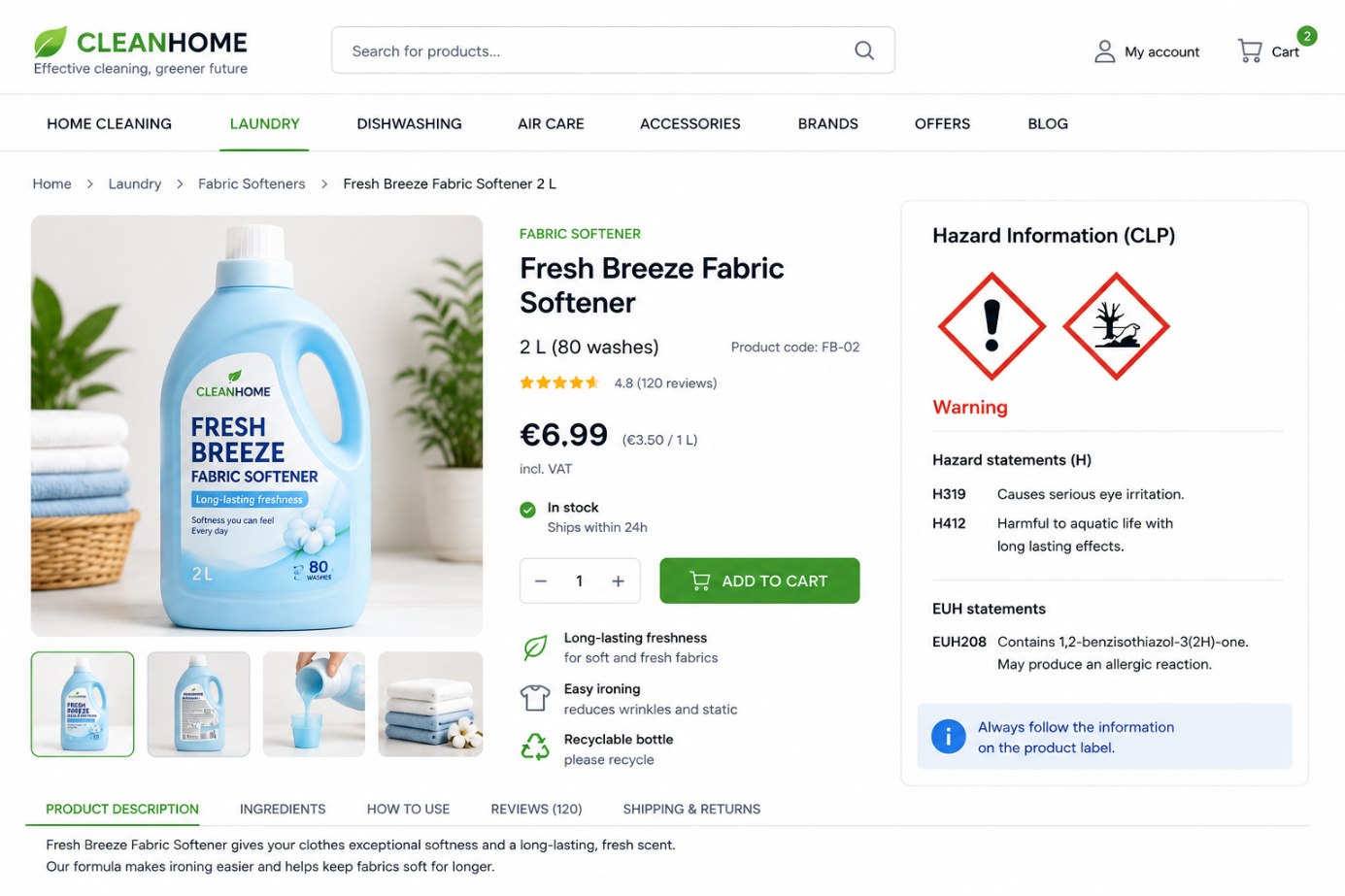 CLP-compliant online product page showing hazard pictograms and safety information
For packages made available to the general public, requirements concerning the nominal quantity may also apply if this information is not specified elsewhere on the package.
Want a broader overview of what is changing? Read our free guide to the new CLP Regulation.
CLP Product Page Checklist
1. Are the Correct Hazard Pictograms Displayed?
If your product classification requires CLP hazard pictograms, the applicable pictograms should be clearly presented in the online offer.
Do not rely solely on a photograph of the packaging. Labels in product images can be too small, compressed or difficult to read, particularly on mobile devices.
2. Is the Correct Signal Word Included?
Depending on its classification, a product may require the signal word Danger or Warning.
The information displayed online should correspond to the current product classification and physical label.
3. Are the Correct H-Statements Displayed?
Hazard statements describe the nature and, where appropriate, the degree of a product's hazard.
Examples include:
- H225 – Highly flammable liquid and vapour.
- H315 – Causes skin irritation.
- H319 – Causes serious eye irritation.
The statements displayed online should correspond to the classification of the specific product. Copying information from similar products can create inconsistencies between the online offer, Safety Data Sheet (SDS) and physical label.
4. Are the Required P-Statements and Supplemental Information Included?
The new distance-selling requirements refer to the label elements specified in Article 17, not only pictograms and H-statements.
This means the online offer may also need to include applicable precautionary statements (P-statements) and supplemental label information, including relevant EUH statements where required.
These elements can easily be missed when product pages are created or updated manually.
5. Does the Product Page Match the Current CLP Label?
An SDS is updated. The classification changes. A new physical label is created — but the online product page still contains the previous information.
This becomes a significant challenge when managing hundreds or thousands of products.
Valid Labels helps businesses manage regulatory information from the SDS through to the physical label and information displayed online, reducing the need to maintain separate versions of the same CLP data.
6. Is the Information Available in the Correct Language?
Selling the same chemical product across several EU countries often means managing multiple language versions of CLP information.
Under Article 17(2), the label must be written in the official language or languages of the Member State where the substance or mixture is placed on the market, unless the Member State concerned provides otherwise.
H-, P- and EUH-statements have official regulatory wording. Using the appropriate official wording is therefore important when preparing information for different EU markets.
7. Is the Required Information Clearly Visible in the Online Offer?
Article 48a requires the relevant label elements to be clearly and visibly indicated in a distance-sales offer.
Providing an SDS for download should therefore not be treated as a substitute for displaying the required label elements in the online offer itself.
A useful question to ask is:
Can customers easily find the required CLP information while viewing the product offer?
If not, the product page may need to be reviewed.
Why Managing CLP Product Pages Manually Is Difficult
Checking one product page is relatively simple. Checking hundreds or thousands of products across several markets is not.
Each product may have different:
- hazard classifications;
- pictograms;
- H-statements;
- P-statements;
- EUH statements;
- language versions; and
- SDS revisions.
Every regulatory update can therefore create another product page that needs to be reviewed.
Over time, the physical label and online information can become inconsistent — particularly when SDSs, labels and e-commerce content are managed in separate systems.
For a broader overview of the changes and how to prepare, read the Valid Labels guide to the new CLP Regulation.
Keep Your Online CLP Information Up to Date with Valid Labels
Valid Labels helps manufacturers, distributors and online retailers manage CLP information in one connected workflow.
Upload your Safety Data Sheet and Valid Labels can extract relevant regulatory information, support multilingual CLP content and help create physical labels.
For e-commerce businesses, Valid Labels can also help display required CLP information directly on product pages.
Instead of maintaining the same regulatory data separately across different systems, you can create a connected process:
SDS → CLP data → translations → physical label → online product page
This is particularly useful for businesses managing large product catalogues or selling the same chemical products across multiple EU markets.
Quick CLP Product Page Audit
When preparing your distance-sales offers for the new CLP requirements, check:
- Are the required supplier details and product identifiers provided?
- Are the correct hazard pictograms displayed?
- Is the applicable signal word included?
- Are the correct H-statements shown?
- Are the applicable P-statements included?
- Are the required EUH statements and other supplemental information included?
- Does the information match the current product label?
- Is the appropriate language version available?
- Are the required label elements clearly and visibly presented in the online offer?
- Is there a process for updating the product page when CLP information changes?
If you cannot confidently answer yes to every relevant question, your product page may need another review.
Prepare Your Online Store for the New CLP Requirements
From 1 January 2028, the new CLP requirements for distance sales will require applicable Article 17 label elements to be clearly and visibly indicated in the offer.
For businesses with large product catalogues, the challenge is not simply adding this information once. It is keeping it accurate across products, languages, markets and future regulatory updates.
With Valid Labels, SDS data, multilingual CLP labels and online product information can be managed as part of one connected workflow.
Want to prepare for the upcoming changes? Read our free guide to the new CLP Regulation or try Valid Labels.
Nikola Kopczyńska
Content Specialist, ValidLabels
Kasper Stasiak founded ValidLabels after working directly with European chemical exporters on CLP compliance workflows. ValidLabels is built by Awakast P.S.A., based in Wrocław, Poland.
Related articles
CLP Compliance
How to Launch a CLP-Regulated Product in a New EU Market
Expanding a chemical product into another EU country? Learn what to check before launch, from CLP labels and languages to UFI and poison centre notifications.
CLP Compliance
Multilingual CLP Labels: 5 Options for Selling Across Europe
Compare five ways to manage multilingual CLP labels across Europe, including single-language, multilingual, fold-out, overlay and print-on-demand labels.